2–4 days
Research framing
We agree research questions, user groups and success criteria with stakeholders.

We interview users, observe real workflows, and analyze competitors so every design decision starts from evidence, not opinion.





Get a free consultation
Free consultation · reply within one business day
In shortUX research services are user experience (UX) research programs that combine generative research, for example user interviews and contextual inquiry, with evaluative research, for example card sorting and tree testing. Our UX research program takes 4–8 weeks, costs $25,000–$60,000, and delivers personas, journey maps and a Jobs to be Done (JTBD) opportunity map.
UX research, also called user research, is the systematic study of user goals, behaviors and problems through interviews, observation and testing, conducted to guide product and design decisions. UX research runs in 2 modes: generative research finds what to build, and evaluative research checks whether a design works for users.
User experience research services, or user research services, differ from usability testing services in breadth: usability testing measures task success on an existing design, while a UX research program also studies needs, workflows and markets before any design exists. The UX research method follows the human-centered design process of ISO 9241-210. Our guide to UX research methods shows which method answers which product question.
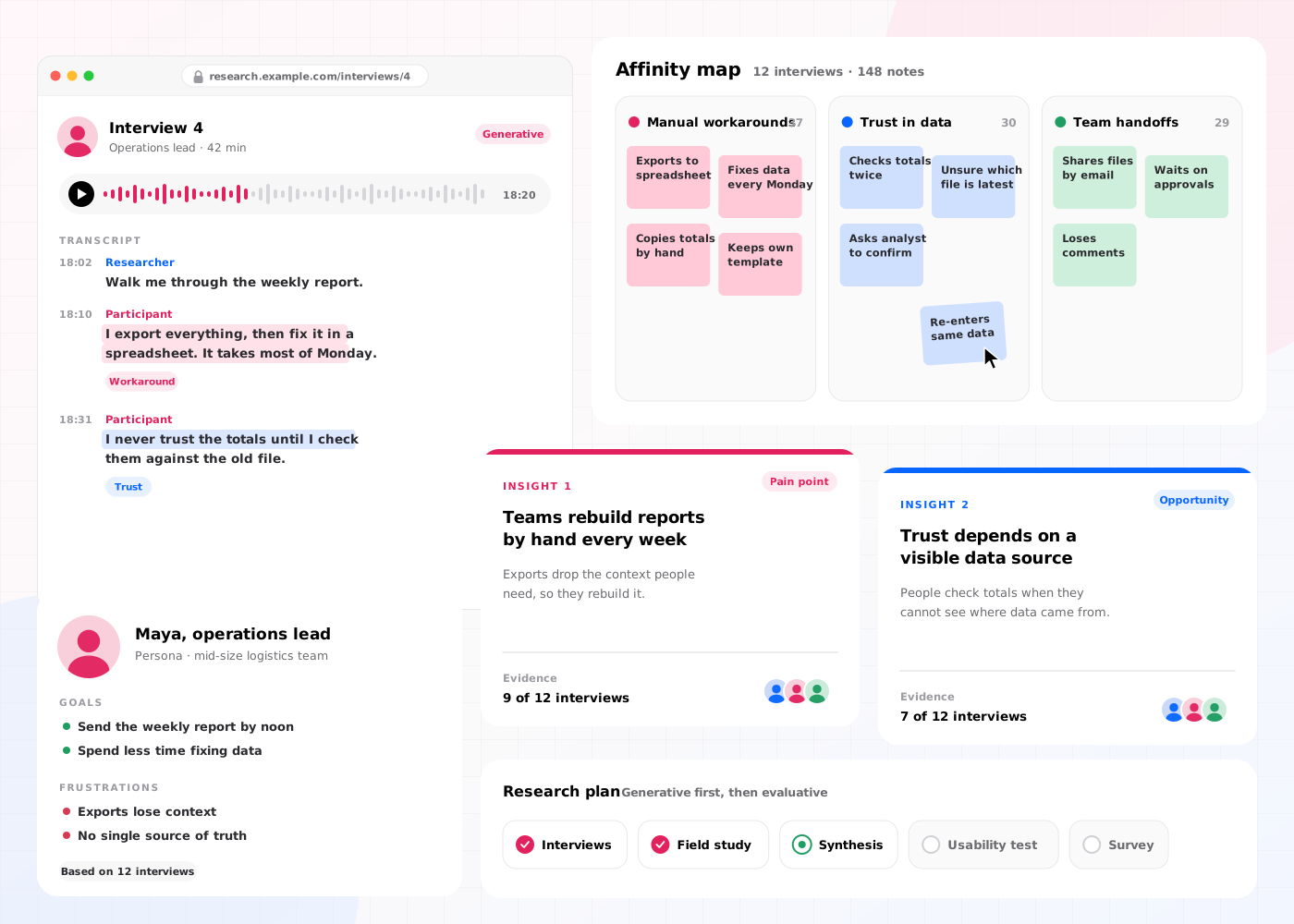
Our UX research services include 6 deliverables: a research plan, user interviews, a contextual inquiry, a card sort and tree test, personas and journey maps, and a Jobs to be Done opportunity map.
Research questions, participant criteria and methods are agreed in 1 document, for example 12 user interviews across 2 user groups.
10–15 one-hour interviews uncover goals and pain points, for example the spreadsheet workaround a clinician uses for a missing report.
Researchers observe 4–6 users in the real work setting, for example a warehouse shift or a hospital ward.
Optimal Workshop studies test the information architecture (IA), for example the menu labels that 30–50 participants expect.
Findings become 2–4 personas and 1 journey map per persona, for example the steps, emotions and pain points of first-time setup.
User jobs are ranked by importance and current satisfaction, for example the job "reconcile invoices at month-end".
The UX research process takes 4–8 weeks (20–40 working days) and runs in 5 steps, from research framing to the findings readout.
We agree research questions, user groups and success criteria with stakeholders.
We screen and schedule participants through a recruitment panel or the client's customer list.
Researchers run user interviews and contextual inquiry sessions and record every session.
Card sorts, tree tests and concept tests check the early information architecture and design concepts.
Findings are tagged in Dovetail, turned into personas, journey maps and a JTBD opportunity map, and presented in a 90-minute readout.
UX research has 4 benefits: UX research increases feature adoption, improves design decisions, reduces development waste and develops a research repository.
Building features for validated user jobs increases the share of users who adopt each new feature.
Evidence from interviews and observation improves how designers and product managers choose between design options.
Testing concepts before development reduces the engineering weeks spent on features users do not need.
Tagged findings in Dovetail develop a searchable research repository that grows with every study.
UX research defines what to build through generative and evaluative methods; usability testing checks whether a specific design works through task-based sessions. A UX research program includes usability testing as 1 evaluative method.
| Criterion | UX research | Usability testing |
|---|---|---|
| Question answered | What to build and why | Whether a design works |
| Methods | User interviews, contextual inquiry, card sorting and concept tests | Moderated and unmoderated task-based sessions |
| Main output | Personas, journey maps and a JTBD opportunity map | Task success rate and observed failures |
| Timeline | 4–8 weeks | 1–3 weeks per round |
| Price on this site | $25,000–$60,000 | Part of a $25,000–$60,000 research sprint |
UX research costs $25,000–$60,000 and takes 4–8 weeks. Our UX research services pricing depends on 4 factors: the number of user groups, the number of participants, the number of methods and the recruitment difficulty.
A program with 1 user group, 10 user interviews and 1 card sort sits near $25,000. A program with 3 user groups, 20 user interviews, on-site contextual inquiry and hard-to-recruit participants, for example hospital clinicians, sits near $60,000. Teams that need a product strategy built on the findings add UX consulting services. Before you fund a study, price it against the cost of being wrong.
Our guide on how to choose a UX research agency shows how to compare quotes on these 4 factors plus the readout.
A product team should invest in UX research services for a web or mobile application in 5 situations:
Book a 45-minute UX audit session. We review your product and identify the top three friction points.
Book a UX auditWe design UI and UX for Healthcare, SaaS, Media and Enterprise products.
Send us your project. A design lead reviews it and schedules a call within one business day. We sign an NDA before the first technical discussion if you prefer.
These answers cover UX research services from consulting and journey study cost to app research, methods, participants, remote sessions, personas and startups.
Still have a question?
A design lead answers every message within one business day.
Talk to a design leadUX research consulting, or user research consulting, is advice on what your team should learn from users, without a full study. Teams that want UX research consultants to advise rather than run fieldwork get our UX consulting services: 2–3 weeks, $5,000–$15,000 and a prioritized UX strategy roadmap. UX research services are the done-for-you UX design research study: in 4–8 weeks for $25,000–$60,000, our researchers recruit participants, run the fieldwork and deliver personas, journey maps and a JTBD opportunity map.
In our UX research services, a user journey study runs inside a program that costs $25,000–$60,000, takes 4–8 weeks and delivers 2–4 personas with 1 journey map per persona. The price moves with 4 factors: user groups, participants, methods and recruitment difficulty. A study for 1 user group sits near the low end of that range; 3 user groups, on-site contextual inquiry and hard-to-recruit participants push it near $60,000.
UX research for web and mobile applications follows our 5-step, 4–8-week process. User interviews and contextual inquiry show how people use the app, and card sorts, tree tests and concept tests check its navigation and early design concepts. Teams that want UX research and design services in one engagement, through to the user interface (UI), can choose our mobile app UI UX design services or web app design services, which each start with a research step.
Generative research finds user needs and opportunities before design, for example through user interviews. Evaluative research tests a design against user needs, for example through tree testing or usability testing. Our guide to generative vs evaluative research shows when to use each and how they combine.
UX research needs 10–15 interview participants per user group and 5 participants per round of qualitative usability testing, per Nielsen Norman Group guidance for usability tests.
Yes. Remote UX research runs user interviews and card sorts over video calls and online tools, for example Zoom and Optimal Workshop; contextual inquiry needs on-site visits. Remote sessions with clinicians and patients add their own rules for screen sharing and recordings, covered in our guide to healthcare UX research. Remote sessions also suit bioscience and health users: our St. Louis UX design agency page explains how we schedule them around lab and clinic hours.
Yes. Every UX research program delivers 2–4 personas built from interview data, with 1 journey map per persona.
Yes. UX research for a startup, for example 8–10 user interviews, shows which problem to solve before the startup spends engineering budget on a minimum viable product (MVP).
 ChecklistHealthcare UX Research, Studying Clinicians and Patients Within HIPAA
 GuideQuantitative UX Research, When to Measure and When to Ask Why
 GuideUX ROI, How to Price a Research Study Before You Run It
 GuideUser Persona Template, Built From Interviews Instead of Guesses
 ComparisonGenerative vs Evaluative Research, Explore the Problem or Test a Fix
 ArticleImportance of UX Research and What Skipping It Really Costs