3–5 days
Platform and catalogue review
We review the platform, for example BigCommerce, the search engine such as Algolia, and the product information management (PIM) data behind filters.

E-commerce design work must reduce friction at every step and drive measurable conversion improvements.





Get a free consultation
Free consultation · reply within one business day
In shortE-commerce UI UX design shapes the user interface (UI) and user experience (UX) of a retail business beyond the checkout funnel: site search, merchandising, loyalty, omnichannel journeys and seller tools. Our engagements for retailers, direct-to-consumer (DTC) brands, marketplaces and business-to-business (B2B) sellers run 4–8 weeks, cost $25,000–$60,000, and ship on Shopify, Adobe Commerce or Salesforce Commerce Cloud.
 Anyday
 Digno
 Elia Wellness
 Mass Media Co.
 Vocable
 Parents Connect
 Nitro
 TradeZella
E-commerce UI UX design is the design of every customer-facing and staff-facing screen a retail business runs, from site search and loyalty accounts to the seller dashboard of a marketplace. The work connects the online store with physical stores and customer service, so shoppers meet 1 brand in every channel.
Merchandisers manage search rules, store associates fulfil buy online, pick up in store (BOPIS) orders, and marketplace sellers manage payouts, each in a different tool. Conversion work on product listing pages, product detail pages and checkout belongs to our e-commerce UX design services; this page covers the wider commerce operation around that funnel.
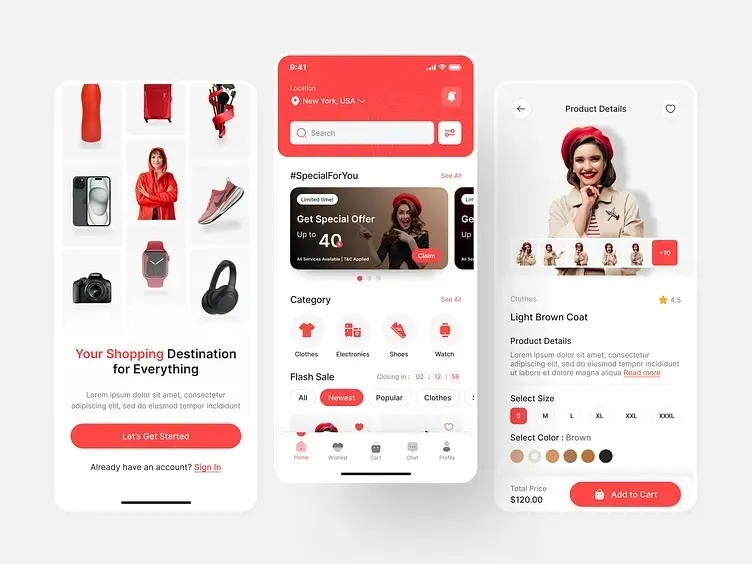
We design 6 types of e-commerce products: site search and navigation, merchandising tools, loyalty and account areas, omnichannel journeys, marketplace seller dashboards and B2B commerce portals.
Autocomplete and zero-result pages turn vague queries into products, for example typo-tolerant suggestions grouped by category and brand.
Merchandisers pin, boost and bury products, for example a rule editor that previews the first 24 results.
Members check points, tiers and order history, for example a tier-progress card showing points left before free shipping.
Shoppers move between app, website and store, for example BOPIS order status and returns started online.
Third-party sellers manage listings, stock and payouts, for example a bulk listing upload with row-level errors.
Trade buyers order against negotiated prices, for example quick order by stock keeping unit (SKU) and purchase-order approval.
4 UX challenges are specific to e-commerce: search queries in shopper language, catalogue data quality, channel inconsistency and the needs of 2-sided marketplaces.
Shoppers type "red dress for a wedding" while the catalogue uses internal names, so search design depends on synonyms and zero-result pages.
Missing attributes and inconsistent sizes break filters, so designers specify the attributes each category requires.
Prices, stock and points differ between app, website and store when systems disagree, so screens show when stock data was updated.
Sellers want fewer listing fields and shoppers want complete product information, so research covers both sides together.
Our commerce design process takes 4–8 weeks (20–40 working days) and runs in 5 steps, from the platform and catalogue review to the platform-ready handover.
We review the platform, for example BigCommerce, the search engine such as Algolia, and the product information management (PIM) data behind filters.
We analyse site search logs for zero-result queries and interview shoppers plus merchandisers, store associates or sellers.
Designers produce search, loyalty or seller screens as a Figma prototype, reusing platform components where the theme supports them.
5 shoppers per round test search tasks, and 3–5 staff users test merchandising or seller tasks with real catalogue data.
Developers receive Figma files mapped to Shopify sections or Salesforce Commerce Cloud components.
E-commerce UX designs revenue journeys that cross channels and staff tools; general product UX designs tasks inside 1 application. Catalogue data, promotions and payment rules shape almost every commerce screen.
| Criterion | E-commerce UX | General product UX |
|---|---|---|
| Users | Shoppers, merchandisers, store associates and marketplace sellers | 1 primary user group |
| Constraints and regulation | Payment Card Industry Data Security Standard (PCI DSS) scope, consumer protection rules and platform theme limits | App store and platform guidelines |
| Testing | Search, account and seller tasks with real catalogue data | Core tasks with sample data |
| Accessibility | Web Content Accessibility Guidelines (WCAG) 2.2 AA across product images, filters and payment fields, with Americans with Disabilities Act (ADA) Title III exposure | WCAG 2.2 AA |
| Success metrics | Search exit rate, revenue per visitor, repeat purchase rate and seller listing time | Task success rate and time on task |
Related:mobile app UI UX design servicesdesign system services
Commerce design work costs $25,000–$60,000 for a 4–8 week research and design sprint. The price depends on 4 factors: the platform's theme limits, the number of channels, the user groups beyond shoppers and catalogue data quality.
A site search and zero-result redesign for a Shopify store with 1 catalogue sits near $25,000. A marketplace with a shopper app, seller dashboard and loyalty program across 3 channels sits near $60,000.
5 standards and regulations shape e-commerce UX:
Each option below draws on our core UI UX design services, from user research to usability testing, scoped to the users and workflows of your product.
Heuristic review, analytics, and usability findings turned into a prioritized fix list.
02Moderated studies, concept validation, and A/B testing that catch problems before they ship.
03Component libraries, tokens, and documentation that scale across teams.
04Website UX and UI built around clear structure and conversion.
05Native-feeling iPhone and iPad interfaces built on Apple's Human Interface Guidelines.
06Discovery, product pages, and checkout designed to remove purchase friction.
Book a 45-minute UX audit session. We review your product and identify the top three friction points.
Book a UX auditThese answers cover the 5 questions retail and marketplace teams ask most about commerce design beyond checkout.
Still have a question?
A design lead answers every message within one business day.
Talk to a design leadYes. Seller dashboard design covers onboarding, bulk listing upload, stock, orders, returns and payouts, and each flow is tested with 3–5 real sellers before development.
Yes. Site search design covers autocomplete, ranking rules, results filters and zero-result pages, with the top 100 queries from site search logs used as test material.
Yes. Shopify loyalty apps such as Smile.io and Yotpo expose theme blocks and APIs, so a custom points and tiers design ships without a headless rebuild.
Yes. B2B buyers order against negotiated prices, credit terms and approval limits, so B2B portals need quick order by SKU, saved lists, purchase-order approval and invoice history instead of promotional banners.
An e-commerce design project takes 4–8 weeks, which equals 20–40 working days. A multi-brand storefront with a shared design system takes 8–16 weeks and costs $60,000–$180,000.
Send us your project. A design lead reviews it and schedules a call within one business day. We sign an NDA before the first technical discussion if you prefer.