
Key takeaways
- Pick UX research methods from the research question: a why question needs a qualitative method, a how-many question a quantitative one.
- Nielsen Norman Group's landscape sorts methods by data source (say or do), data type (why or how many) and context of use.
- Sample sizes differ by method: 5 participants per round of qualitative usability testing, 10–15 interview participants per user group, 40 for a quantitative test.
- Nearly every project benefits from more than one method, so plan on 2–3, each answering the question the previous one raised.
UX research methods each answer a different kind of question, and one product meeting can raise three at once: why do trial users stall at setup, can people find invoices in the new menu, and how many accounts hit the export bug? The first calls for user interviews, the second for a tree test and the third for product analytics or a survey. The meeting is invented for illustration.
Picking the study from the research question, not from the method your team ran last time, is the core of user experience (UX) research. Our UX research services combine five of these methods in one program. The sections below route eight product questions to a method, place each on Nielsen Norman Group's map, match it to a stage and give its sample size.
What are UX research methods?
UX research methods are the techniques a product team uses to collect evidence about users, such as interviews, surveys and usability testing, and each one answers a different research question.
They are the working tools of UX research, the discipline that studies what users try to do and where they struggle. UX research in turn serves user-centered design, the approach of ISO 9241-210, titled "Human-centred design for interactive systems". Teams also call the toolkit user research methods, user experience research methods or UX research techniques.
What is the UX methodology, and how does it differ from a method?
The usual UX methodology is user-centered design, the design approach that grounds each product decision in evidence about users; UX research methods and techniques are the tools that gather that evidence.
Dovetail's guide to method vs methodology puts it simply: a method is a procedure for reaching an objective, and a methodology is the strategy underneath it. The third level below is our own framing:
- Methodology: the strategy, for example user-centered design or an ethnographic approach.
- Method: the procedure that collects data, for example a usability test.
- Technique: one way of running part of a method, for example the think-aloud protocol, where a participant voices their thoughts while using the interface.
In everyday writing the words blur, so searches for UX research methodology and UX research techniques land on the same pages. Name the level you mean in your research plan.
Is user research the same as UX research?
Yes, user research and UX research name the same discipline, so user research methods and UX research methods are one toolkit under two names.
The useful contrast is with market research, which asks who buys and at what price, while user research asks how people use a product and where they get stuck. When a stakeholder asks for user research but wants a market size, name the mismatch before planning.
How do user research techniques relate to academic research types?
User research techniques borrow from academic research, but no single standard list of seven research methods exists, and UX teams choose by product decision rather than by textbook category.
- Quantitative designs are often taught as four types, for example descriptive, comparative, quasi-experimental and experimental in Sacramento State's library guide, though textbooks differ on the exact set.
- Qualitative approaches number five in John Creswell and Cheryl Poth's Qualitative Inquiry and Research Design: Choosing Among Five Approaches (4th edition, 2018): narrative research, phenomenology, grounded theory, ethnography and case study.
Lists of "seven types" mix these with other categories and vary by author. In product work, ethnography lives on as the field study and contextual inquiry, and the experiment returns as A/B testing. Start from your question, then find the method.
Which UX research method answers your research question?
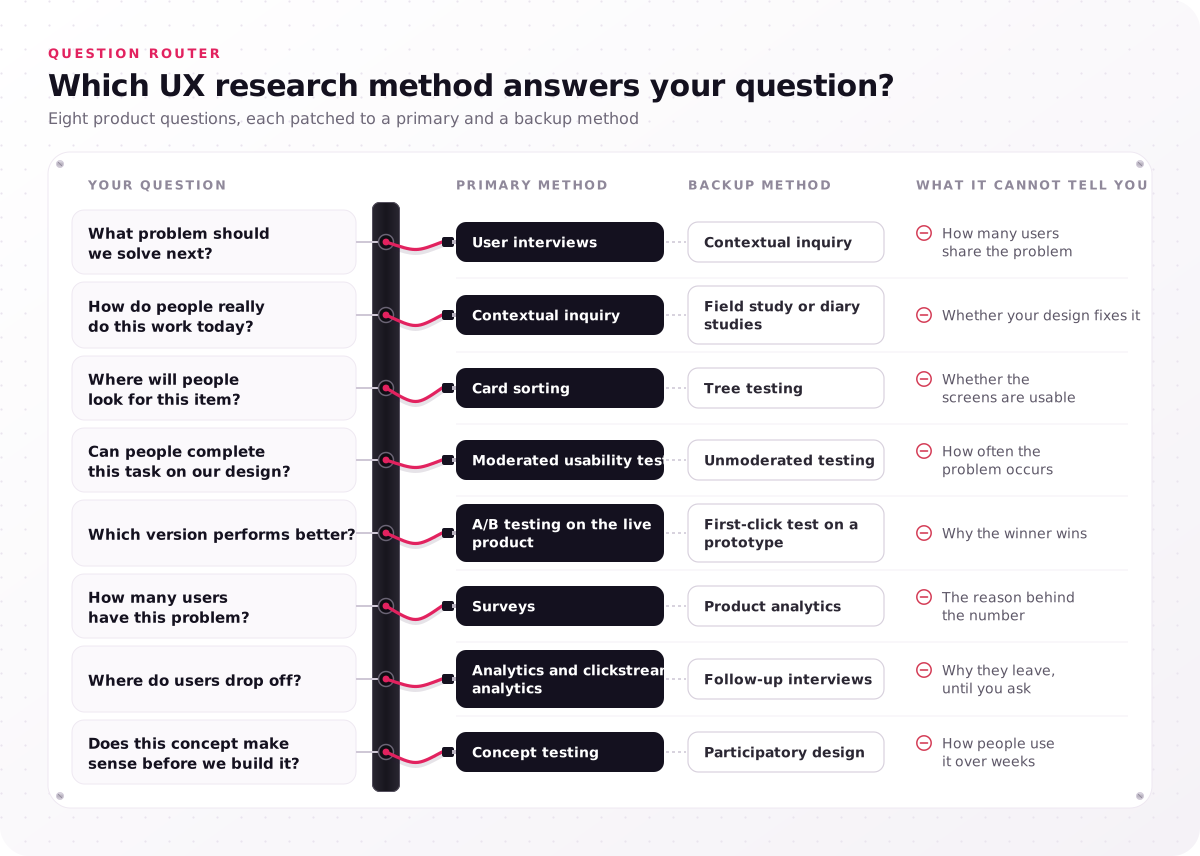
Pick the UX research method by the kind of research question: interviews for why, usability tests for whether people can complete a task, analytics or surveys for how many.
No single technique is the most effective, because a flawless survey still cannot explain why people abandon a form. Find your question below to see when to use each method, run the primary one and keep the backup for when time or traffic runs short.
| Your question | Primary method | Backup method | What it cannot tell you |
|---|---|---|---|
| What problem should we solve next? | User interviews | Contextual inquiry | How many users share the problem |
| How do people really do this work today? | Contextual inquiry | Field study or diary studies | Whether your design fixes it |
| Where will people look for this item? | Card sorting | Tree testing | Whether the screens are usable |
| Can people complete this task on our design? | Moderated usability test | Unmoderated testing | How often the problem occurs |
| Which version performs better? | A/B testing on the live product | First-click test on a prototype | Why the winner wins |
| How many users have this problem? | Surveys | Product analytics | The reason behind the number |
| Where do users drop off? | Analytics and clickstream analytics | Follow-up interviews | Why they leave, until you ask |
| Does this concept make sense before we build it? | Concept testing | Participatory design | How people use it over weeks |
The rule behind most rows: a why question needs a qualitative method, a how-many question a quantitative one, and a question about future behavior is unreliable in any method. Self-predictions are weak evidence, so ask what people did last time.
Our guide on how open, closed and hybrid card sorting work covers the structure row, and workflow questions go to contextual inquiry, where you watch users do real work. Write your question as one sentence, then pick its row.
What are the main types of UX research?
The main types of UX research come from two axes, what people say vs what they do, and why against how many, so each research question falls in one quadrant.
Christian Rohrer's landscape for Nielsen Norman Group (NN/g), When to Use Which User-Experience Research Methods, places 20 methods on three dimensions, and most lists of the types of user research methods echo them:
- Data source: the attitudinal vs behavioral split (what people say against what they do).
- Data type: the qualitative vs quantitative question (why, or how many). Qualitative data comes from watching or hearing people; quantitative data arrives through an instrument such as a user survey or analytics tool.
- Context of use: natural (a field study), scripted (usability benchmarking), limited (card sorting) or none (a desirability study, where people pick words for their reaction to a product).
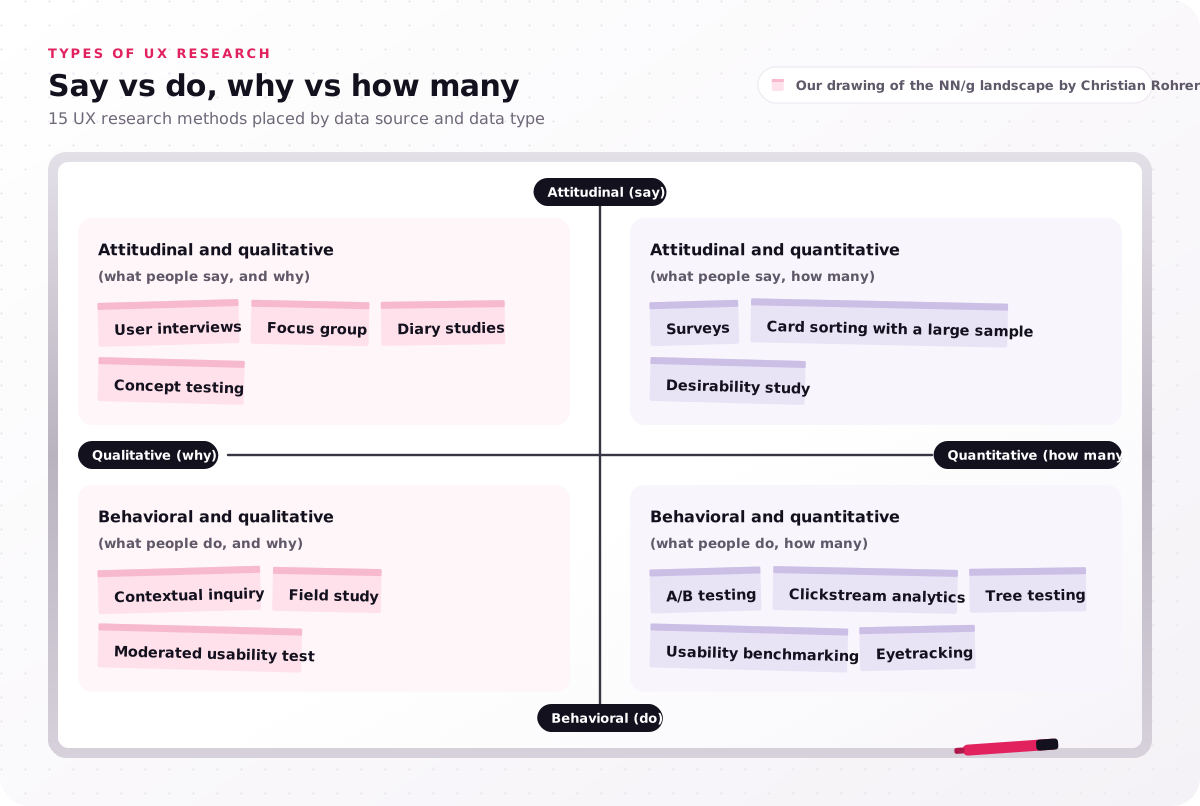
- Behavioral and qualitative (what people do, and why): contextual inquiry, field study, moderated usability test.
- Behavioral and quantitative (what people do, how many): A/B testing, clickstream analytics, tree testing, usability benchmarking, eyetracking.
- Attitudinal and qualitative (what people say, and why): user interviews, focus group, diary studies, concept testing.
- Attitudinal and quantitative (what people say, how many): surveys, card sorting with a large sample, desirability study.
Some methods sit in the middle: a usability test is qualitative with 5 participants and quantitative with 40. Two practical axes sit on top, moderation (moderated or unmoderated) and research setting (remote or in-person), both described in the User Interviews field guide chapter on types of user research. A later guide will cover quantitative UX research in depth. Label each planned study on all three NN/g dimensions before you choose a tool.
What is the difference between attitudinal and behavioral research?
Attitudinal research records what people say about a product, while behavioral research records what they do, and Rohrer advises that most usability studies should rely on behavior.
Interviews and surveys are self-reported; usability tests and analytics capture observed behavior. A user who says "I export every report" in an interview can be checked against export events in analytics before the team builds around that habit. When a question involves both belief and action, pair one of each.
What is the difference between qualitative and quantitative UX research?
Qualitative UX research explains why something happens and how to fix it, while quantitative UX research measures how many users are affected and how much.
Qualitative research runs on small samples and interpretation; quantitative research needs larger samples and statistics, such as enough traffic for statistical significance in an A/B test. Five usability sessions can show that a date picker confuses people; only analytics or a survey can say how many of your users hit it. Start qualitative when you do not yet know what to count.
Which UX research methods fit each product stage?
User research methods follow the product stage, so the same product decision gets generative methods before design, formative methods during it and summative methods after launch.
NN/g's time dimension names three stages: strategize, design, and launch and assess. Generative research, such as interviews, a diary study or participatory design, shapes what to build during discovery. Evaluative research then checks the work: formative studies improve a design in progress, and a summative evaluation measures the finished product, usually against a competitor or an earlier version of itself, per NN/g's methods glossary. After launch, the User Interviews guide adds continuous research that keeps feedback flowing.
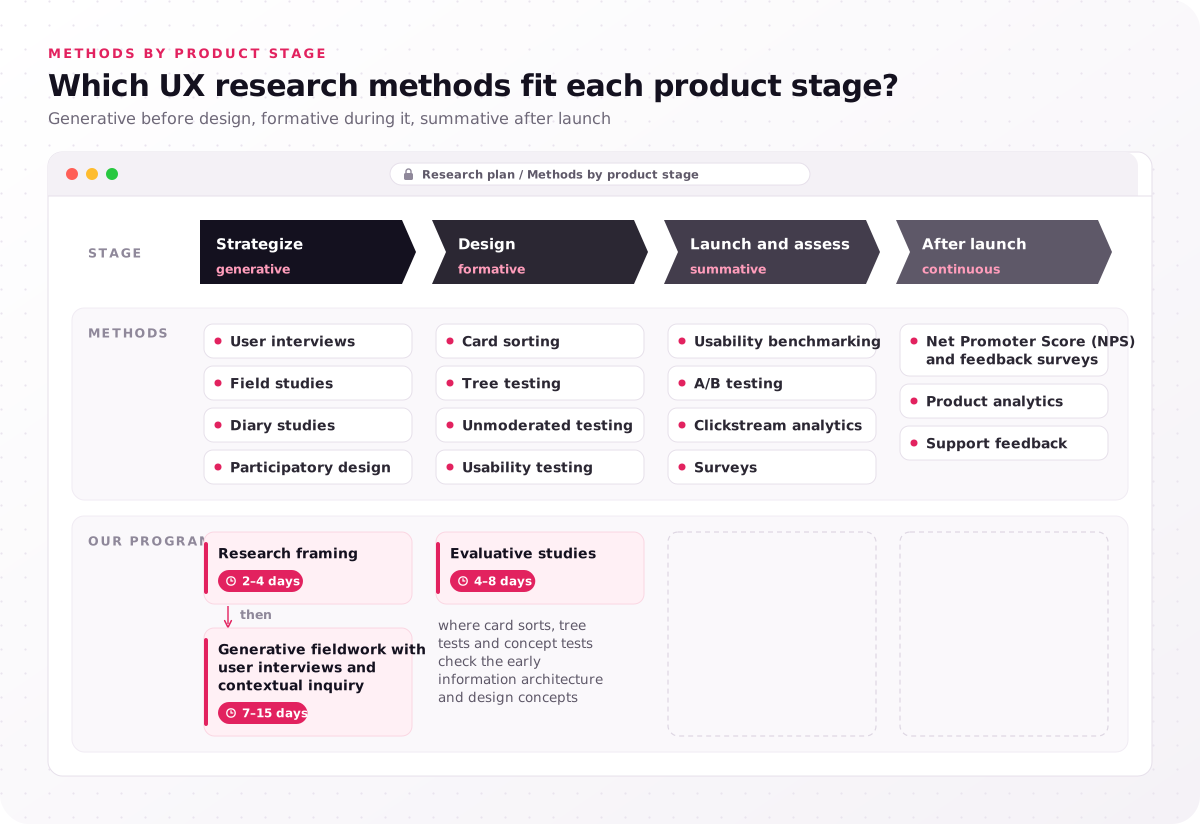
- Strategize (generative): user interviews, field studies, diary studies, participatory design. Our program: research framing (2–4 days), then generative fieldwork with user interviews and contextual inquiry (7–15 days).
- Design (formative): card sorting, tree testing, usability testing, unmoderated testing. Our program: evaluative studies (4–8 days), where card sorts, tree tests and concept tests check the early information architecture and design concepts.
- Launch and assess (summative): usability benchmarking, A/B testing, clickstream analytics, surveys.
- After launch (continuous): Net Promoter Score (NPS) and feedback surveys, product analytics, support feedback.
Our guide to generative and evaluative research goes deeper on that split. Mark your product's stage today, because it removes half the router's rows.
UX research methods by sample size, length and output
User research techniques differ most in sample size, from 5 participants per round of qualitative usability testing to 40 for a quantitative test, as the research question demands.
The table below is a one-table UX research methods cheat sheet that compares 12 methods on the question each answers, data type, data source, sample size, study length, main output and moderation. "Our program" marks figures from our own research program.
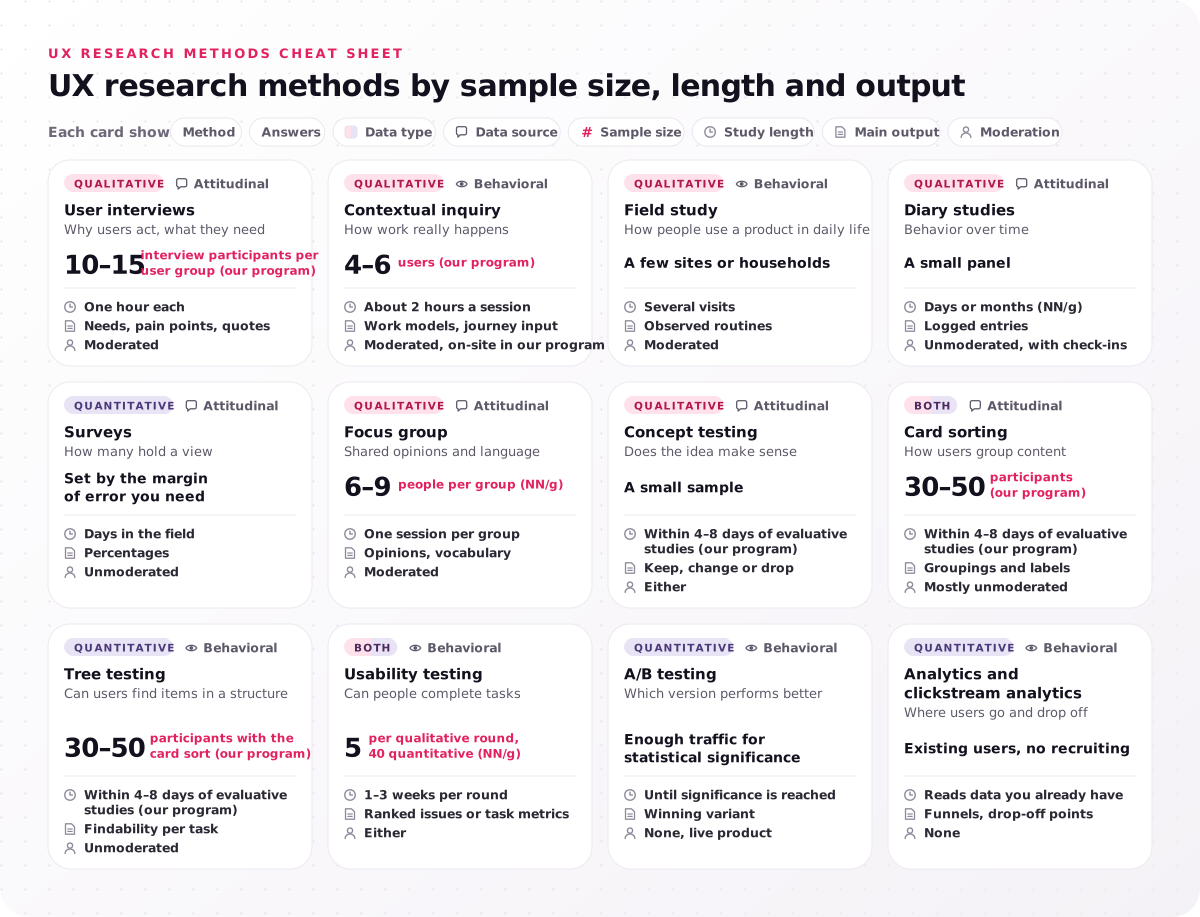
| Method | Answers | Data type | Data source | Sample size | Study length | Main output | Moderation |
|---|---|---|---|---|---|---|---|
| User interviews | Why users act, what they need | Qualitative | Attitudinal | 10–15 interview participants per user group (our program) | One hour each | Needs, pain points, quotes | Moderated |
| Contextual inquiry | How work really happens | Qualitative | Behavioral | 4–6 users (our program) | About 2 hours a session | Work models, journey input | Moderated, on-site in our program |
| Field study | How people use a product in daily life | Qualitative | Behavioral | A few sites or households | Several visits | Observed routines | Moderated |
| Diary studies | Behavior over time | Qualitative | Attitudinal | A small panel | Days or months (NN/g) | Logged entries | Unmoderated, with check-ins |
| Surveys | How many hold a view | Quantitative | Attitudinal | Set by the margin of error you need | Days in the field | Percentages | Unmoderated |
| Focus group | Shared opinions and language | Qualitative | Attitudinal | 6–9 people per group (NN/g) | One session per group | Opinions, vocabulary | Moderated |
| Concept testing | Does the idea make sense | Qualitative | Attitudinal | A small sample | Within 4–8 days of evaluative studies (our program) | Keep, change or drop | Either |
| Card sorting | How users group content | Both | Attitudinal | 30–50 participants (our program) | Within 4–8 days of evaluative studies (our program) | Groupings and labels | Mostly unmoderated |
| Tree testing | Can users find items in a structure | Quantitative | Behavioral | 30–50 participants with the card sort (our program) | Within 4–8 days of evaluative studies (our program) | Findability per task | Unmoderated |
| Usability testing | Can people complete tasks | Both | Behavioral | 5 per qualitative round, 40 quantitative (NN/g) | 1–3 weeks per round | Ranked issues or task metrics | Either |
| A/B testing | Which version performs better | Quantitative | Behavioral | Enough traffic for statistical significance | Until significance is reached | Winning variant | None, live product |
| Analytics and clickstream analytics | Where users go and drop off | Quantitative | Behavioral | Existing users, no recruiting | Reads data you already have | Funnels, drop-off points | None |
The rows fall into three families. Talk to users: interviews, focus groups, surveys and diary studies collect self-reported views; a focus group is one facilitated discussion, so a loud voice can steer it, and participatory design hands users the pen.
Watch users: contextual inquiry and field studies observe real work, and a usability test watches set tasks. Related techniques include the first-click test, which stops after the first click on a screen, the five-second test, which asks what people recall after five seconds, and eyetracking, which records where eyes move and needs special equipment. Our usability testing services run moderated and unmoderated rounds.
Measure users: A/B testing, analytics and clickstream analytics count behavior on the live product, and usability benchmarking repeats scripted tasks to set a benchmark and track it across releases. Heuristic evaluation sits outside all three: experts review the interface against usability principles with no users, so it flags likely problems cheaply but proves none.
Recruiting is the hidden cost in this table: a card sort with 30–50 participants or a quantitative test with 40 needs screening and scheduling before any session runs. Our program budgets a 3–6 day participant recruitment step ahead of fieldwork for that reason. Check the sample size column against your recruiting reach before you commit.
How do you combine UX research methods?
You combine UX research methods by letting each one answer the research question the previous one raised, so every finding gets a second kind of evidence.
Two methods that agree let you triangulate: a drop-off seen in analytics and explained in interviews beats either alone. Rohrer notes that nearly all projects gain when teams combine methods, yet many use only the one or two they know best.
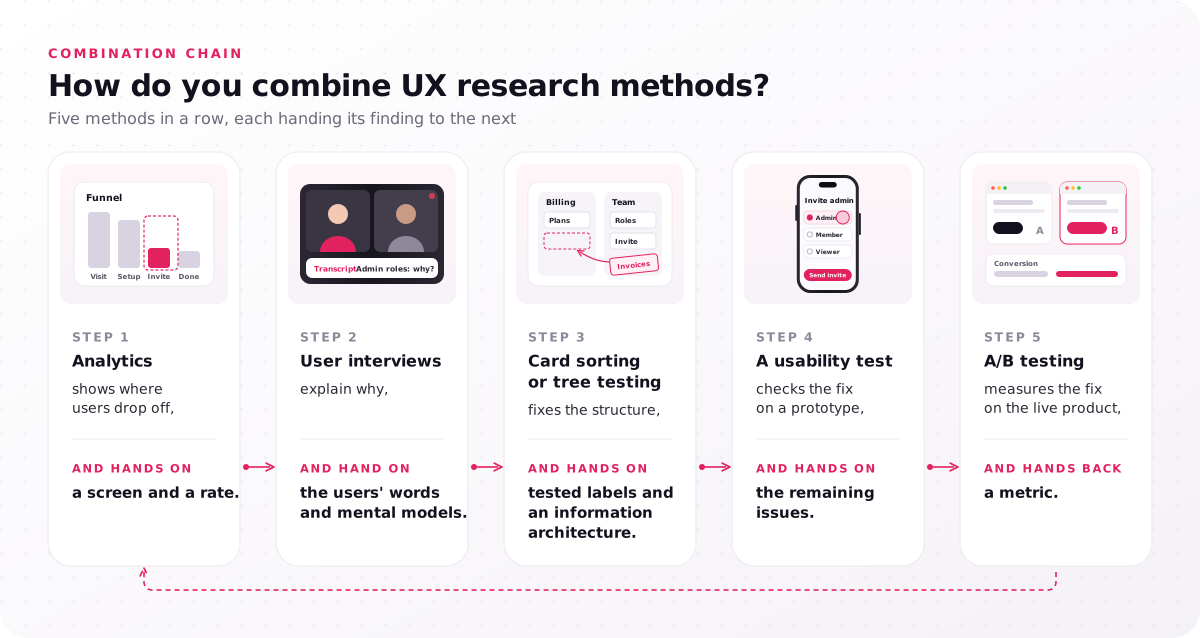
- Analytics shows where users drop off, and hands on a screen and a rate.
- User interviews explain why, and hand on the users' words and mental models.
- Card sorting or tree testing fixes the structure, and hands on tested labels and an information architecture.
- A usability test checks the fix on a prototype, and hands on the remaining issues.
- A/B testing measures the fix on the live product, and hands back a metric.
Take the meeting's first question, why trial users stall at setup, as an illustrative example. Analytics puts the stall on the team-invite screen, a round of admin interviews shows that their mental models of roles do not match the product's, and a usability test of a redesigned prototype shows whether new admins now pick a role unaided. Each method answered one question, and no single one answered all three.
Our program follows the same logic: research plan, participant recruitment, interviews and contextual inquiry, then card sorts and tree tests on the early information architecture, plus concept testing of design ideas. Synthesis turns the findings into personas and journey maps (2–4 personas, 1 journey map per persona) and a Jobs to be Done (JTBD) opportunity map. Our customer journey map template shows how evidence from several methods fills each lane, and our user persona template shows how interview data becomes personas.
In a real engagement for a business-to-business (B2B) marketing platform, the scope of work listed user interviews, and the Mass Media Co. discovery workshop we ran with stakeholders and users covered product definition, strategy, information architecture and user flows.
Findings fragment across methods at synthesis, which is why our five-step research program ends with findings tagged in Dovetail and a 90-minute readout. Before you run a second method, write down what the first must hand it.
Which UX research methods work on a small budget?
On a small budget, user research methods that still answer a research question include 5-user usability tests, customer interviews, unmoderated tree tests and the analytics you already have.
Method cost comes from three lines: recruiting, researcher hours and tools. The table compares common shortcuts by what each still tells you and what you give up.
| Shortcut | What it still tells you | What you lose |
|---|---|---|
| Recruit from your customer list instead of a panel | Real users, fast and cheap | Prospects and churned users; answers lean toward people who stayed |
| Unmoderated instead of moderated sessions | More participants in less time | Follow-up questions in the moment |
| Remote interviews instead of contextual inquiry | Goals and pain points | Observation of the real setting; you get recall instead |
| Existing analytics instead of a new survey | Where behavior changes | Attitudes and reasons |
| One 5-user usability round instead of none | The biggest usability problems | Any percentage or rate |
For a startup, a study of, for example, 8–10 user interviews shows which problem to solve before engineering budget goes into a build. The cheapest useful study is one whose answer changes a product decision; if no result would change the plan, keep the budget.
Which mistakes make UX research methods mislead you?
UX research techniques mislead when the method does not fit the research question, for example a survey asked why or five usability participants asked for a percentage.
- Method-first planning. The team runs the method it knows, so write the research question first and pick from the router.
- Asking about the future. "Would you use this?" invites a guess, so ask about the last time the problem came up.
- Surveys for why questions. A survey counts answers but cannot probe them, so interview first and survey what you found.
- Percentages from small samples. Five participants find problems but cannot measure a rate, so report counts ("3 of 5") and run a quantitative test for a number.
- Navigation questions in interviews. People cannot reliably say where they would look, so let card sorting and tree testing show it.
- No written research question. Recruiting criteria drift without one, so write a research plan naming the question, participants and methods, the first deliverable of our program.
Check your current study plan against this list before you recruit.
When should a research team run the study for you?
Hand the study to a research team once the product decision needs two or more user research methods, hard-to-recruit participants or synthesis your team has no hours for.
Three signals point to outside help:
- Several methods for one decision, because each needs its own recruit, script and analysis before synthesis joins them.
- Hard-to-recruit users such as hospital clinicians, because screening and scheduling them takes longer than a panel order; a planned guide on healthcare UX research will cover them.
- No researcher on the team, because recruiting, sessions and synthesis span weeks.
Our program runs 4–8 weeks and costs $25,000–$60,000, and what sets the price of a research program is the number of user groups, participants and methods, plus recruitment difficulty. Our guide on the importance of UX research shows what skipping that spend costs, a planned guide on UX return on investment (ROI) will cover whether it pays off, and you can read how to compare research agencies before you hire one.
Write the question down first, as one sentence that ends in the decision it settles, and run it through the router before anyone books a participant. A row that points to three methods and a recruit nobody can staff is the moment to send us your research question, so the first call starts from your decision rather than from a method list. Every project begins with a free consultation and a fixed-scope proposal.
FAQs
Is UX research being replaced by AI?
No. Artificial intelligence (AI) speeds up transcription, tagging and first-pass synthesis, but synthetic users, AI-generated profiles that simulate a user group, cannot stand in for real people. In their NN/g article on synthetic users, Maria Rosala and Kate Moran (2024) advise against using them as a replacement and suggest treating their output as hypotheses to test. We use AI to speed up production, while the judgment about what to design comes from research and pattern recognition across 200+ products.
What is the 5-user rule for usability testing?
The 5-user rule is Jakob Nielsen's guidance that a qualitative usability test with 5 users finds about 85% of the problems, so several small rounds beat one large one (NN/g, 2000). It does not cover quantitative studies, which need about 40 participants, or card sorting, which runs with 30–50 participants in our program.
What are the three types of user testing?
No single standard trio exists; teams usually mean one of three pairs. Moderated testing has a researcher present to ask follow-up questions, while unmoderated testing runs on tools such as Maze without one; qualitative tests find problems while quantitative tests measure them; and remote tests run over video while in-person sessions share a room.
What are the five steps of UX research?
In our program the five steps are research framing, participant recruitment, generative fieldwork, evaluative studies, and synthesis and readout. Together they take 4–8 weeks (20–40 working days), with recruitment and synthesis each scheduled as a step of its own.
How many UX research methods should one study use?
Plan on two or three: one to find or explain the problem and one to check or measure the answer. Rohrer's NN/g landscape says nearly all projects benefit from multiple methods, and our program pairs generative fieldwork with evaluative studies in one engagement.