3–5 days
Flow and behaviour audit
We review existing flows and components and list every missing state, inconsistent transition and unclear feedback message.

Flows, micro-interactions, states, and motion that make every action clear, responsive, and satisfying to use.





Get a free consultation
Free consultation · reply within one business day
In shortAn interaction design agency defines how a digital product responds to every user action through user flows, micro-interactions, user interface (UI) states and motion design. Our interaction design engagement takes 4–8 weeks, costs $25,000–$60,000, and ends with an interactive prototype and motion specifications for developers.
Interaction design is the discipline that defines how a digital product responds to user input, including the triggers, feedback, states and transitions of every control. Interaction designers specify what happens on tap, click, hover, drag, error and loading, and how long each transition lasts.
Interaction design differs from visual design in focus: visual design sets colour, type and layout, while interaction design sets behaviour over time. An interaction design agency works inside a wider product team, for example alongside digital product design services for a new product, and sizes targets with Fitts's law.
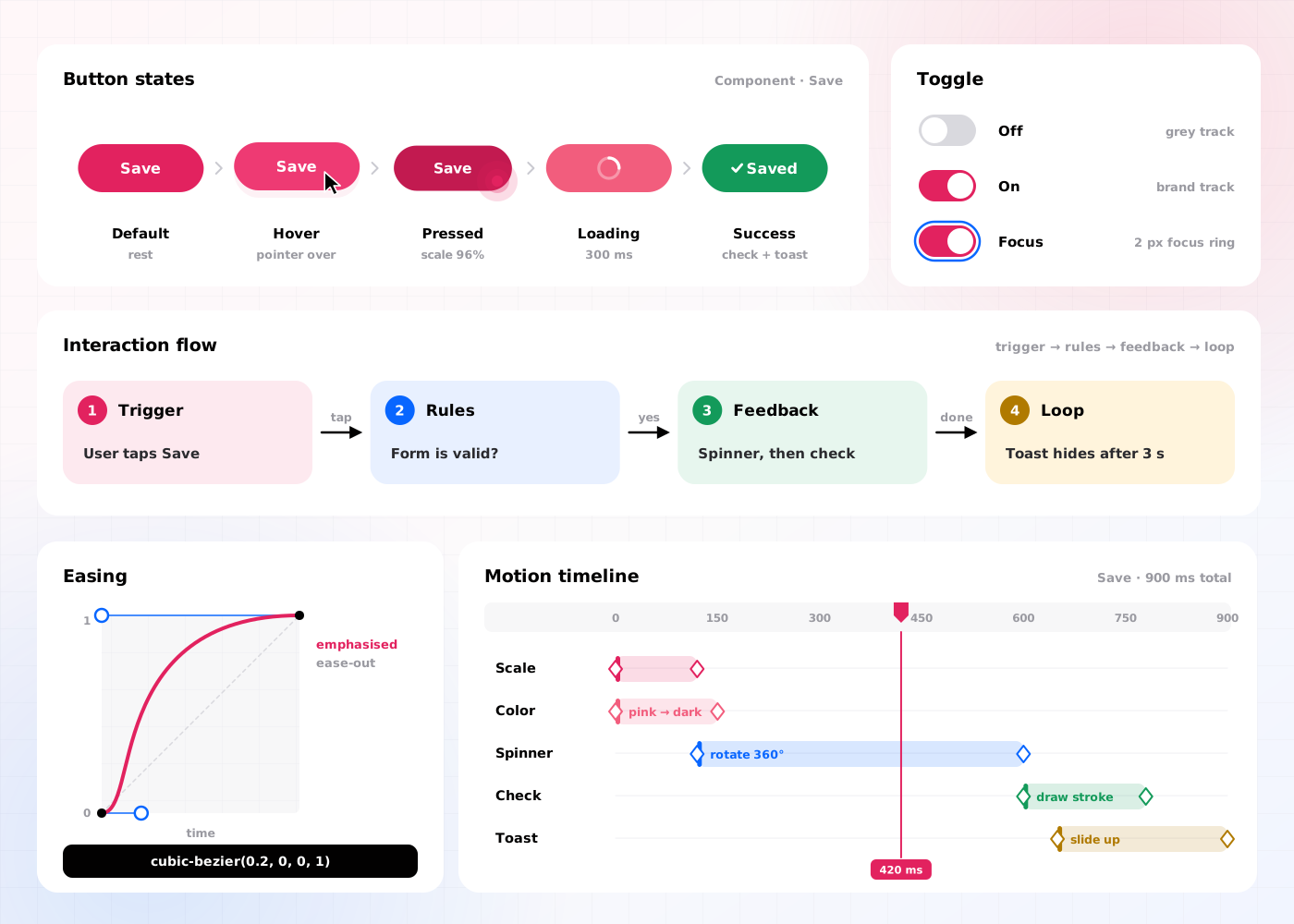
Our interaction design agency services include 6 deliverables: interaction flows, a micro-interaction library, UI states, a motion system, an interactive prototype and developer motion specifications.
Flow diagrams map every trigger and response, for example form submission, undo and multi-step checkout.
Each micro-interaction is defined by trigger, rules, feedback and loops, for example a like button, a toggle and pull-to-refresh.
Every component gets a full set of UI states, for example default, hover, focus, pressed, disabled, loading, empty and error.
Duration and easing tokens standardize transitions, for example the Material Design 3 short durations of 50–200 ms for small feedback and medium durations of 250–400 ms for larger transitions.
A high-fidelity prototype in Figma or ProtoPie shows real behaviour, for example conditional logic, variables and gesture input.
Lottie or Rive files and timing tables go to engineering, for example exact duration, easing curve and delay per transition.
The interaction design process takes 4–8 weeks (20–40 working days) and runs in 5 steps, from flow audit to developer handoff.
We review existing flows and components and list every missing state, inconsistent transition and unclear feedback message.
Designers map triggers and responses for each flow and define the UI states of every component in Figma.
Designers define duration and easing tokens and design each micro-interaction with a reduced-motion variant for users who set prefers-reduced-motion.
5 users per round complete tasks in the interactive prototype, and designers adjust timing and feedback after each round.
We hand over motion specifications, Lottie or Rive files and state documentation in Storybook, then review the built interactions with engineers.
Interaction design has 4 benefits: it increases task completion rate, improves perceived responsiveness, reduces development rework time and develops consistent product behaviour.
Clear feedback on every action shows users what happened and what to do next, which increases the share of users who finish each task.
Visible feedback within 100 ms of each tap or click improves the sense that the product reacts instantly.
Exact duration, easing and state specifications reduce the time engineers spend guessing behaviour and reworking animations.
A shared micro-interaction library develops consistent behaviour across teams, so the same control reacts the same way on every screen.
Interaction design defines how components behave; a design system packages components, design tokens and governance rules so teams reuse the components. Interaction design output, for example motion tokens and UI states, feeds directly into the design system.
| Criterion | Interaction design | Design system |
|---|---|---|
| Focus | Behaviour, feedback and motion | Reusable components and tokens |
| Main output | Interactive prototype and motion specifications | Component library, tokens and documentation |
| Owner after handoff | Product designers and engineers | Design system team |
| Timeline | 4–8 weeks | 8–16 weeks |
| Price on this site | $25,000–$60,000 | $60,000–$180,000 |
Related:design system servicesdigital product design services
Interaction design costs $25,000–$60,000 and takes 4–8 weeks. The price depends on 4 factors: the number of user flows, the number of components, the number of platforms and the number of prototype testing rounds.
An interaction design project for 1 platform, 3–4 user flows and 20 components sits near $25,000. A web and mobile project with 10 user flows, 60 components, a full motion system and 2 testing rounds sits near $60,000. Gesture-heavy iOS and Android work runs through mobile app UI UX design services.
A product team should hire an interaction design agency in 5 situations:
Book a 45-minute UX audit session. We review your product and identify the top three friction points.
Book a UX auditWe design UI and UX for SaaS, Healthcare, Gaming and AI products.
Send us your project. A design lead reviews it and schedules a call within one business day. We sign an NDA before the first technical discussion if you prefer.
These answers cover the 5 questions buyers ask most about an interaction design agency.
Still have a question?
A design lead answers every message within one business day.
Talk to a design leadYes. An interaction design agency designs micro-interactions and screen transitions and delivers each animation as a Lottie or Rive file with a timing table.
No. Interaction design is one part of user experience (UX) design: UX design also covers research, information architecture and content, while interaction design covers behaviour, feedback and motion.
Yes. Motion design meets WCAG 2.2 when every non-essential animation has a reduced-motion variant triggered by the prefers-reduced-motion setting.
An interaction design agency uses Figma for flows and UI states, ProtoPie for advanced prototypes, and Lottie or Rive for production animations.
An interaction design project takes 4–8 weeks, which equals 20–40 working days, from flow audit to developer handoff.