1–2 days
Kickoff and scope
We confirm the mission outcome, user groups, compliance requirements and approval chain, often in person near the Beltway.

Headquartered in Reston, Virginia, a Silver Line ride from downtown. Senior researchers and designers build accessible, plain-language digital services for agencies, nonprofits and federal contractors across the DC metro.





Get a free consultation
Free consultation for Washington, D.C. teams · reply within one business day
In shortOur UX design agency, Washington DC's close neighbor in Reston, Virginia, works with civic tech teams, associations, nonprofits and government contractors. We research, design and test accessible digital services aligned with Section 508, the U.S. Web Design System and plain-language rules, starting at $5,000 for a 2–3 week audit.
A UX design agency in Washington DC should deliver researched, tested and accessible digital services that the public, members or program staff can complete without calling a help desk. For federal work that also means designs that meet Section 508 on day one, not after a remediation project.
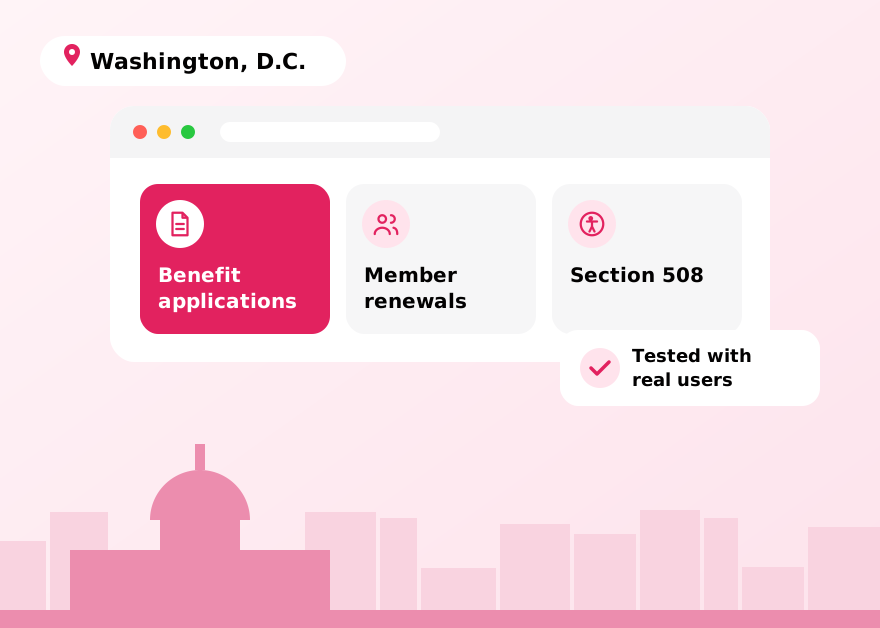
Products built around the capital serve citizens applying for benefits, members renewing dues and contracting officers reviewing deliverables, and each audience tolerates little friction, so accessibility practice comes first. Our team is based in Reston, in Northern Virginia, so workshops in the District are a short trip, while daily work runs remotely on Eastern Time. See our UX research services.
Four standards shape most federal and civic projects in the region: Section 508, the U.S. Web Design System, the Plain Writing Act and the security boundary of a FedRAMP-authorized cloud.
A typical DC engagement bundles 6 workstreams, each scoped to the program, the contract vehicle and the people who will actually use the service.
Sessions with applicants, caseworkers or association members, for example 8 grant applicants and 4 program officers.
Manual review with screen readers and keyboard-only navigation, mapped to Section 508 and WCAG 2.2 success criteria.
A map of every touchpoint, including paper forms, call centers and back-office queues behind a single online application.
Figma screens built on USWDS tokens, extended where a program needs custom components such as eligibility checkers.
Plain-language headings, error messages and help text tested with readers who are new to the program.
Moderated rounds that include participants who use assistive technology, not just the default user group.
A research and design engagement here usually spans 4–8 weeks and moves through 5 phases, with check-ins timed to your program reviews and any contracting milestones.
We confirm the mission outcome, user groups, compliance requirements and approval chain, often in person near the Beltway.
Interviews, analytics review and an accessibility baseline reveal where applicants or members drop off today.
Program staff, policy owners and engineers sketch the future service together, on site in the DC area or remotely.
Designers build a clickable Figma prototype with final plain-language copy, reviewed with your team twice a week.
Assistive-technology users test the prototype, fixes are made, and annotated specs move to your developers or prime contractor.
Our Reston headquarters gives DC buyers the same time zone and easy in-person access as a downtown firm, with remote-first delivery that keeps senior rates lower. A downtown office mainly matters to teams that want designers on site every day.
| Factor | Our team (Reston, VA) | Downtown DC firm |
|---|---|---|
| Time zone | Eastern Time, full business-day overlap | Eastern Time |
| In-person sessions | District, Arlington, Tysons and Maryland suburbs on request | On site |
| Accessibility | WCAG 2.2 AA annotations on every screen | Varies by firm |
| Start time | 1–2 weeks after scope sign-off | Varies by firm |
| Published pricing | $5,000–$15,000 audit, $25,000–$60,000 sprint | Often quoted per contract |
Budget $5,000–$15,000 for a 2–3 week accessibility and UX audit, and $25,000–$60,000 for a 4–8 week research and design sprint. The total moves with the number of user groups, the forms and integrations in scope, and how much content needs rewriting.
Multi-program portals with a USWDS-based design system typically run $60,000–$180,000 over 8–16 weeks. Associations and contractors that need continuous design support can embed a team for $15,000–$40,000 per month. Every quote from our UX design agency, Washington DC associations and contractors included, is fixed-scope, which suits budgets planned around grants, fiscal years or a subcontract ceiling. For portal and back-office work, see our web app design services.
We focus on 5 kinds of organizations common across the DC metro and its industries:
Senior UX guidance, product reviews, and a prioritized roadmap your team can act on.
02Interviews, observation, journey maps, and Jobs-to-be-Done analysis that ground every design decision in evidence.
03Heuristic review, analytics, and usability findings turned into a prioritized fix list.
04Moderated studies, concept validation, and A/B testing that catch problems before they ship.
05Strategy, UX, UI, and validation from one team that stays through launch.
06Flows, micro-interactions, states, and motion that make every action clear.
Book a 45-minute UX audit session. We review your product and identify the top three friction points.
Book a UX auditAnswers to the 5 questions DC program leads, association directors and capture managers raise most often.
Still have a question?
A design lead answers every message within one business day.
Talk to a design leadNo. We are headquartered in Reston, Virginia, and work remote-first. That still makes us a UX design agency Washington DC teams can meet face to face: workshops and research sessions in the District, Northern Virginia or Maryland are simple to schedule.
We can support a prime contractor on research and design tasks. Contract vehicles, clearances and set-aside status should be confirmed with us during scoping, since we do not assume them for every program.
Designs are built and annotated to WCAG 2.2 AA, which exceeds the WCAG 2.0 AA baseline in Section 508. Final conformance also depends on how the code is built, so we review the implemented build with your developers.
Yes, when the program calls for it. Our UX design agency extends USWDS components and tokens in Figma rather than replacing them, which keeps the service consistent with other federal sites.
Work starts 1–2 weeks after the proposal is signed. Procurement steps on your side, such as a purchase order or a task order, can add time before that.
Send us your project. A design lead reviews it and schedules a call within one business day. We sign an NDA before the first technical discussion if you prefer.