5–10 days
Discovery and product strategy
We run stakeholder workshops, map the Jobs to be Done and set success metrics with the Google HEART framework.

Strategy, research, UX, UI, and validation delivered by one team that stays with your engineers through launch.





Get a free consultation
Free consultation · reply within one business day
In shortDigital product design services take a new software product from idea to launch through product strategy, user experience (UX) research, user interface (UI) design and prototype validation. Our digital product design engagement takes 8–16 weeks, costs $60,000–$180,000, and ends with a tested, development-ready product design in Figma.
Digital product design is the end-to-end process of defining, designing and validating a software product, from the first problem statement to the launch-ready user interface. One team covers product strategy, user research, information architecture (IA), interaction design, visual design and usability validation.
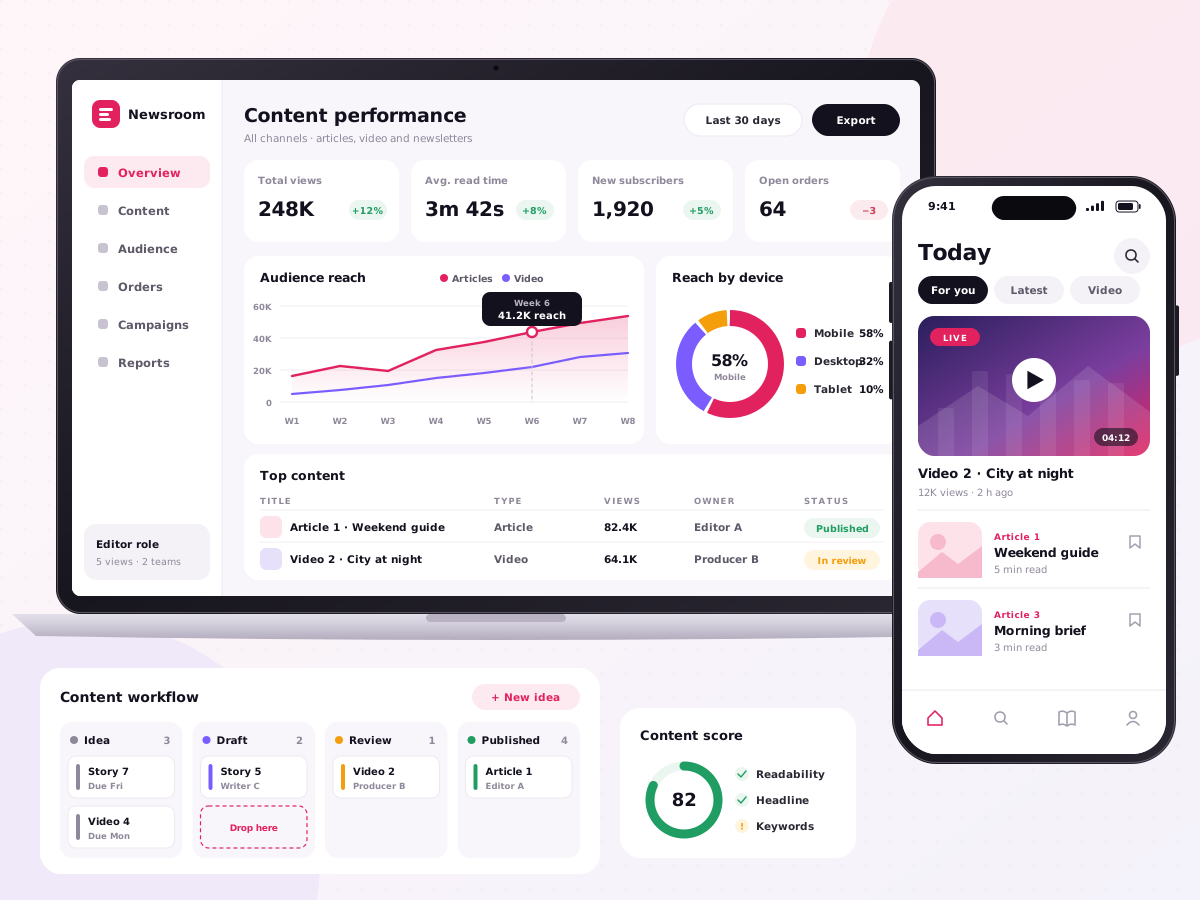
Digital product design starts with evidence: UX research services supply the user needs, and design turns the user needs into screens. Our product design process follows the Double Diamond model, with 2 discovery phases and 2 delivery phases. The same process applies to order, campaign and content tools for media and marketing companies, as our UI UX design for media companies shows.
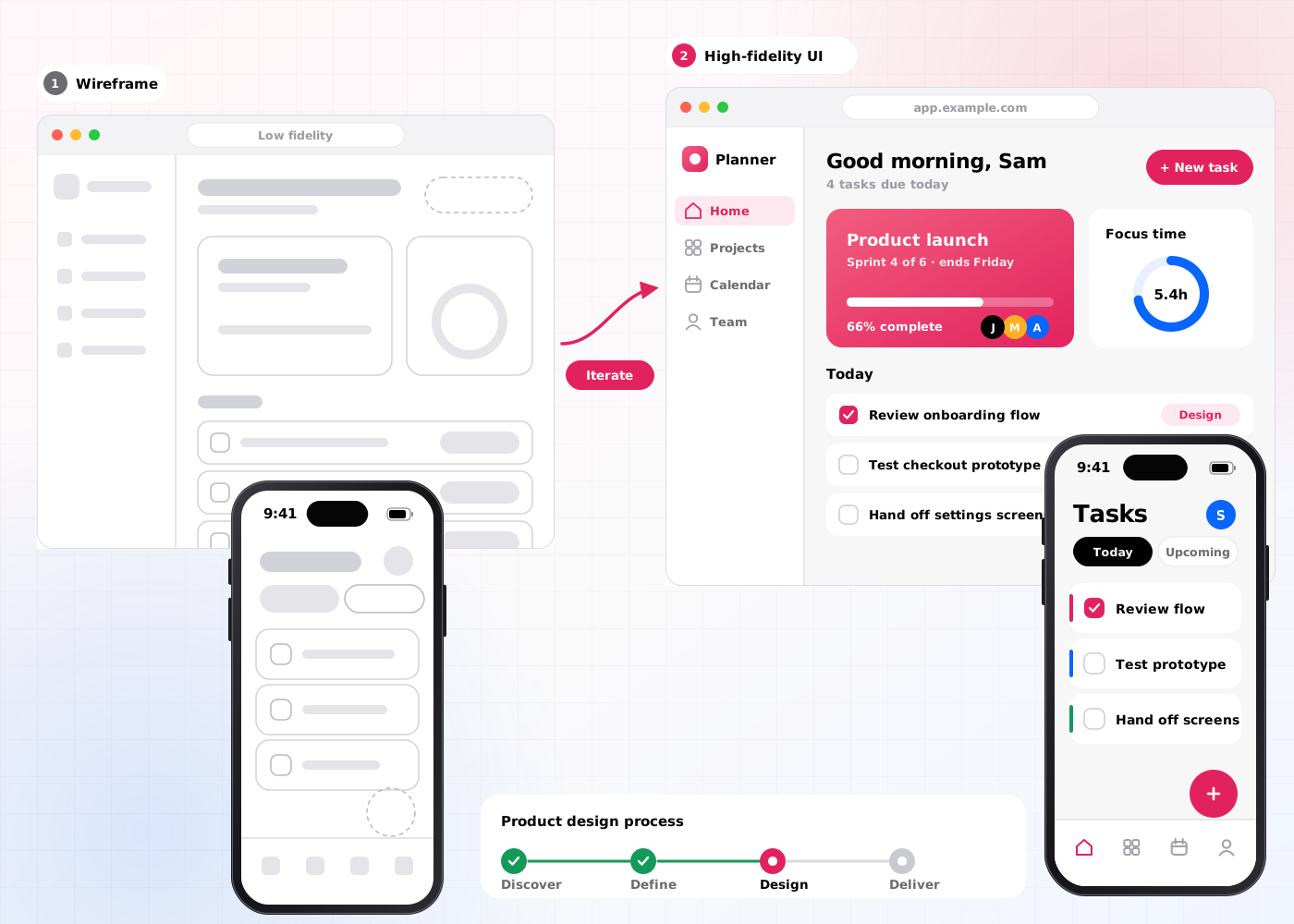
Our digital product design services include 6 deliverables: a product strategy, a user research report, an information architecture, a clickable prototype, a UI design and a developer handoff package.
A 1-page product brief defines target users, Jobs to be Done and success metrics, for example weekly active users and task completion time.
Interviews with 5–8 users per user group produce findings, for example unmet needs, current workarounds and switching triggers.
A sitemap and user-flow diagrams define every screen, for example sign-up, onboarding, the core workflow and settings.
A Figma prototype covers the core user flows, for example the first-run experience and the main task.
High-fidelity screens follow platform guidelines, for example Material Design 3 on Android and the Apple Human Interface Guidelines (HIG) on iOS.
Annotated Figma files, design tokens and component specifications go to engineering, for example spacing, states and breakpoints.
The digital product design process takes 8–16 weeks (40–80 working days) and runs in 5 steps, from discovery to developer handoff.
We run stakeholder workshops, map the Jobs to be Done and set success metrics with the Google HEART framework.
Researchers interview 5–8 users per user group and synthesize the findings in Dovetail.
Designers build the sitemap and user-flow diagrams for every core task.
5 users per round complete tasks in the clickable prototype on Maze, and each round ends with a System Usability Scale (SUS) score.
Designers produce screens that meet Web Content Accessibility Guidelines (WCAG) 2.2 level AA, hand the Figma files to engineering and stay with the engineers through launch.
Digital product design has 4 benefits: it increases activation rate, improves the user experience, reduces rework cost and develops a validated product roadmap.
Onboarding flows tested with real users before development increase the share of new sign-ups who complete the first key task.
One team designs strategy, flows and UI together, which improves consistency across every screen and platform.
Usability issues found in a clickable prototype cost hours to fix, while the same usability issues found after launch cost development sprints.
Each validation round develops the product roadmap with evidence, for example which features users need at launch and which features wait.
Digital product design covers a new product end to end, from strategy to launch; web app design redesigns or extends the workflows of an existing logged-in application. Teams with no product yet start with digital product design.
| Criterion | Digital product design | Web app design |
|---|---|---|
| Starting point | Idea or problem statement | Existing web application |
| Scope | Strategy, research, UX, UI and validation | Workflows, tables, permissions and UI |
| Main output | Validated product design and handoff package | Redesigned screens and component specifications |
| Timeline | 8–16 weeks | 8–16 weeks |
| Price on this site | $60,000–$180,000 | $60,000–$180,000 |
Related:web app design servicesUI UX design services for startups
Digital product design costs $60,000–$180,000 and takes 8–16 weeks. The price depends on 4 factors: the number of platforms, the number of user groups, the number of core user flows and the number of validation rounds.
A single-platform web product with 1 user group, 4–5 core flows and 1 validation round sits near $60,000. A web and mobile product with 3 user groups, 10–12 core flows, 3 validation rounds and a starter component library sits near $180,000. Teams that need a full component library with governance add design system services.
A founder should hire digital product design services in 5 situations:
Book a 45-minute UX audit session. We review your product and identify the top three friction points.
Book a UX auditWe design UI and UX for Startups, SaaS, Gaming, EdTech, Media, Blockchain, AI and Enterprise products.
Send us your project. A design lead reviews it and schedules a call within one business day. We sign an NDA before the first technical discussion if you prefer.
These answers cover the 5 questions buyers ask most about digital product design services.
Still have a question?
A design lead answers every message within one business day.
Talk to a design leadYes. Every digital product design engagement includes 5–8 user interviews per user group and at least 1 usability validation round.
No. Digital product designers deliver Figma files, design tokens and component specifications, and the client's engineers write the code.
Yes. Digital product design starts from a problem statement, and the discovery step turns the rough idea into a product brief with target users and success metrics. Already hold recent user evidence? Run our six-question test for skipping discovery before you scope the engagement.
A product design agency staffs strategy, research, UX and UI designers on one team, while a freelancer covers 1–2 of those disciplines.
Digital product design takes 8–16 weeks, which equals 40–80 working days, from discovery to developer handoff.