




Enterprise software UI/UX design

Enterprise UX design agency for internal tools and complex workflows

As an enterprise UX design agency, we design the internal tools that employees of large organizations use all day, from order management and approval workflows to performance systems, enterprise dashboards and admin consoles. We design them so order takers, managers, approvers and executives each see only the tasks their role owns, and we test the core user flows with those employees before your engineers build it. One senior team carries the work from discovery to developer-ready Figma files.

200+ products designed · in business since 2017
Trusted by teams at
  • NBCUniversal
  • 7-Eleven
  • Groupon
  • Sterne Kessler
  • Nitro League
  • Senior designers only
  • NDA before the first call
  • Reply within 1 business day

Get a free consultation

Free consultation · reply within one business day

In shortAn enterprise UX design agency designs the software that employees use to run a large organization: order management, approval workflows, performance and goal tracking, enterprise dashboards and admin consoles. Our digital product design services include full enterprise product design, which takes 8–16 weeks and costs $60,000–$180,000, and its core user flows are tested in prototype rounds before engineering starts.

Case studies

Enterprise UI UX case studies

30%
increase in order processing efficiency Mass Media Co. reports
200+
products designed since 2017
Definition

What is an enterprise UX design agency?

An enterprise UX design company designs the user interface (UI) and user experience (UX) of enterprise software, the internal tools employees use every day, so complex workflows take fewer steps.

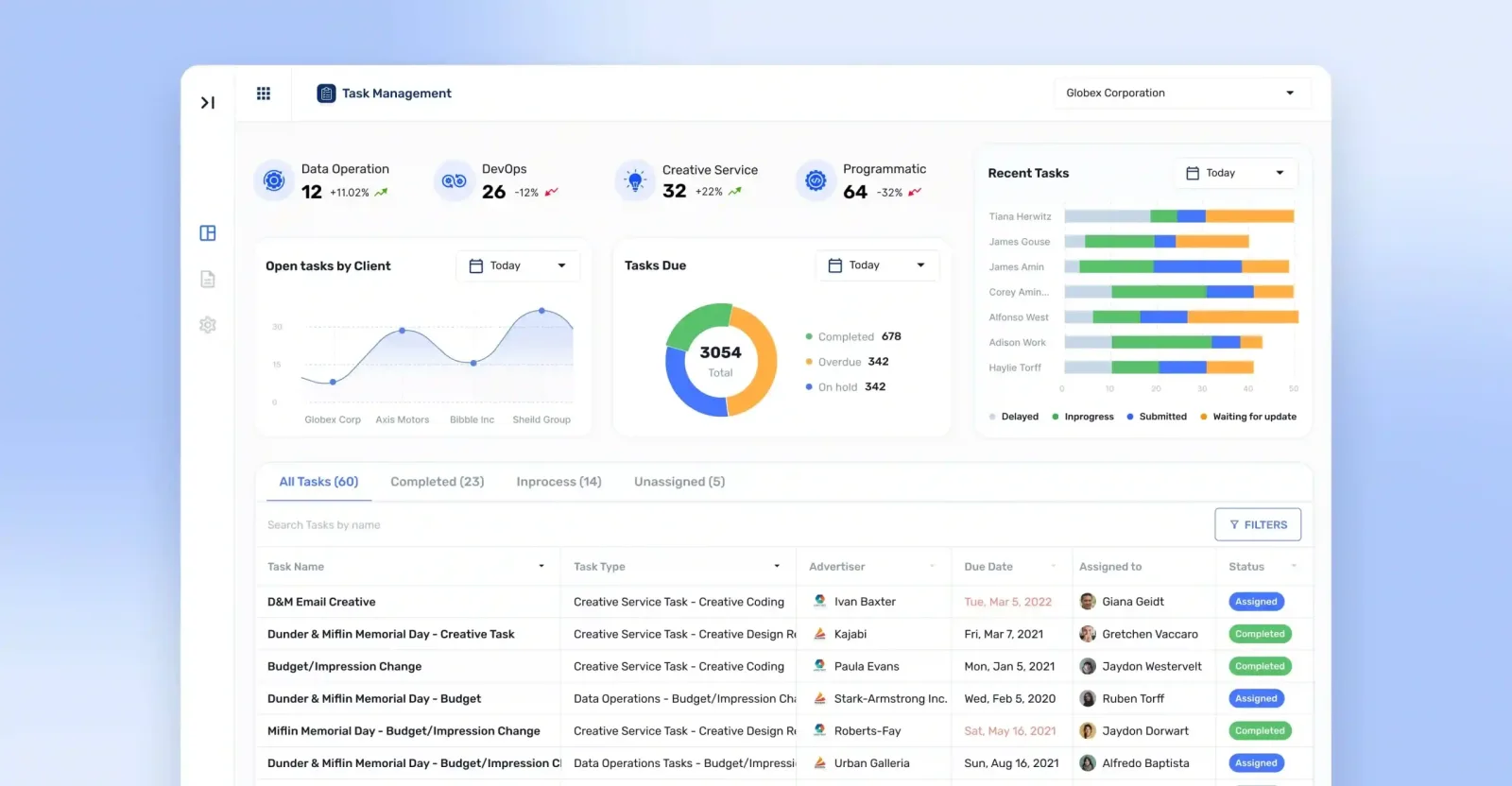
Enterprise UX design is the design of software that employees use to do their jobs inside a large organization, and enterprise software design often means complex apps for expert daily users. It sits within our digital product design services, part of our UI UX design services. We design the screens; your engineers write the code. The image shows a task management dashboard we designed for a business-to-business (B2B) marketing platform.

Mass Media Co. task management dashboard with task counters, an open-tasks-by-client chart, a task flow donut and a task table
Task management dashboard
Timeline
8–16 weeks
Investment
$60,000–$180,000
Deliverables
6 included
What's included

Which tools does our enterprise UX design agency design?

As a B2B UX design agency, we design six kinds of enterprise software for internal use, each mapped to the user roles that work in it. The first, third and fourth items rest on published case studies (Mass Media Co. and Digno); the other three are enterprise applications we offer to design, with no public project to show yet.

Internal operations platforms

Order intake and fulfillment run in one place, as at Mass Media Co., where the team builds a customer order from data products and channels and sees the estimated cost while it works.

Approval workflows

Multi-step approvals give each role clear permission states: what it can view, edit or approve on one screen. An audit log, the record inside the software of who approved what and when, sits beside every decision.

Performance and goal management systems

Goals, tasks and scores for each employee sit beside management by objectives (MBO), key performance indicators (KPIs) and objectives and key results (OKRs), as on Digno.

Enterprise dashboards

Leaders read the same data at organization, department and employee level and drill down from a total to the rows behind it; our dashboard UX design service covers these screens.

Admin consoles with roles and permissions

Role-based access control (RBAC) decides which screens and actions each employee of one organization gets, and single sign-on lets staff log in with their work account. Products sold as software as a service (SaaS) to many customer accounts belong on our SaaS UI UX design page.

Legacy system modernization

One form of legacy modernization is workflow consolidation: several legacy systems redesigned as one platform that employees move to step by step. Our web app design services cover logged-in tools of this kind.

Benefits

What makes enterprise UX design different from consumer UX?

Enterprise software UX design serves employees who must use the tool to do their jobs, so it puts efficiency over delight in complex workflows: fewer errors and less time per task. Consumer UX courts people who choose an app; internal tools are judged by the people required to use them.

Employees cannot pick another tool

Use is mandated, so a confusing screen costs time every working day instead of losing a customer. Research starts with the daily users, not with whoever bought the software.

Long workflows across roles

At enterprise scale, with many departments and approval rules, one customer order passes through order takers, managers and finance, so we map each flow end to end before drawing a screen.

Users are experts in their own work

Domain experts know the process better than any designer. Power users who live in the tool ask for shortcuts and dense screens, while an approver who visits twice a month needs each step explained on one page.

Success is measured in time and errors

Productivity metrics such as time on task, error rate and task completion replace engagement goals. Mass Media Co., in our case study below, reports a 3% improvement in task completion.

Overview

How did our enterprise UX design agency help Mass Media Co.?

Our enterprise UX design services merged the complex workflows of separate systems into one platform design for Mass Media Co., which reports a 30% increase in order processing efficiency.

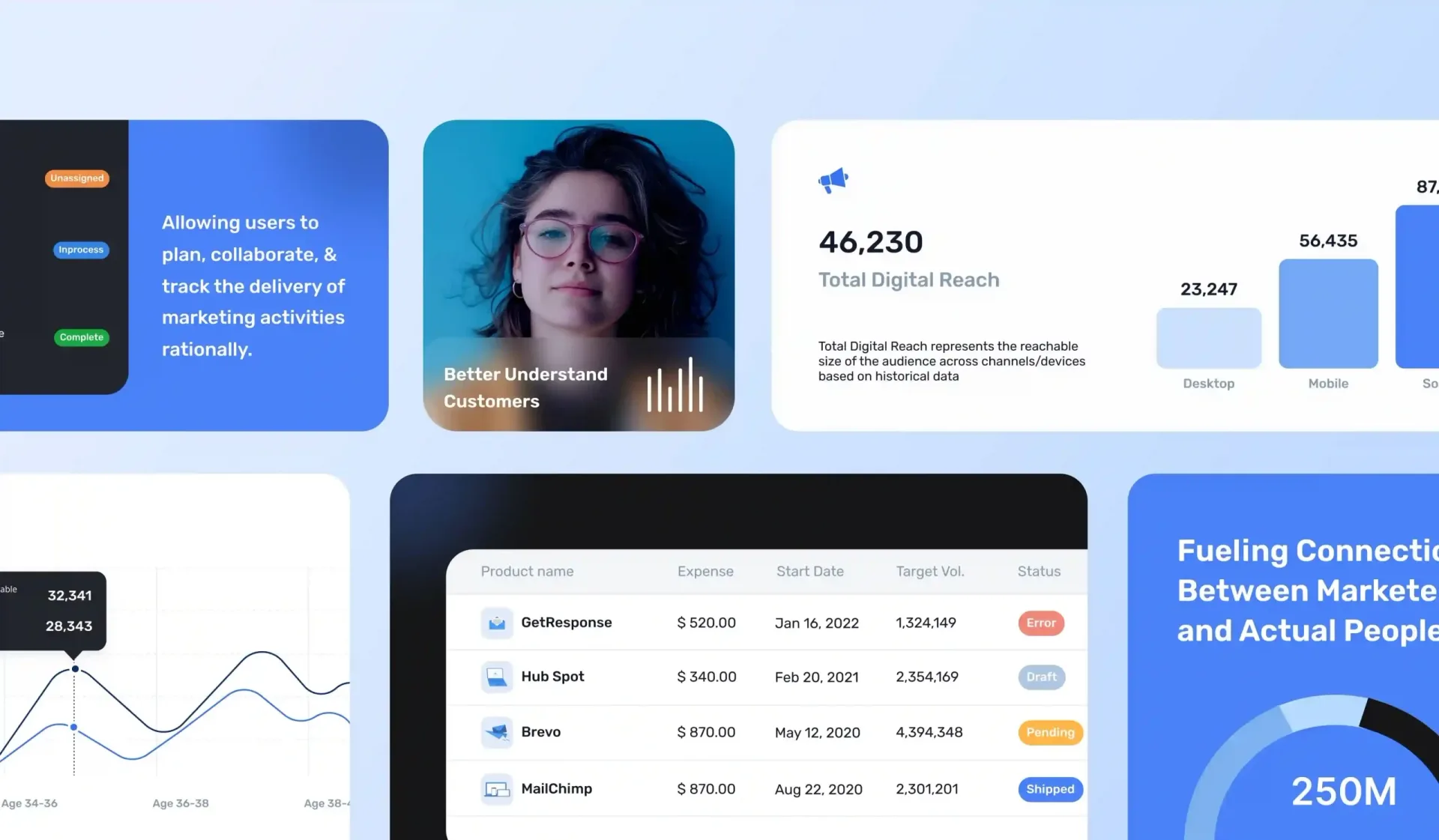
Order takers jumped between disconnected systems to fill one customer order. A discovery workshop with stakeholders and users covered the product definition, strategy, information architecture and user flows. A task management dashboard gathers open tasks by client, and order management shows the estimated cost as an order is built from data products. Because the platform holds personally identifiable information (PII), screens should show each role only what its work needs. The case ties the gain to optimized workflows, automated tasks and tracking; see the Mass Media Co. case study.

Overview

How did enterprise performance design work for Digno?

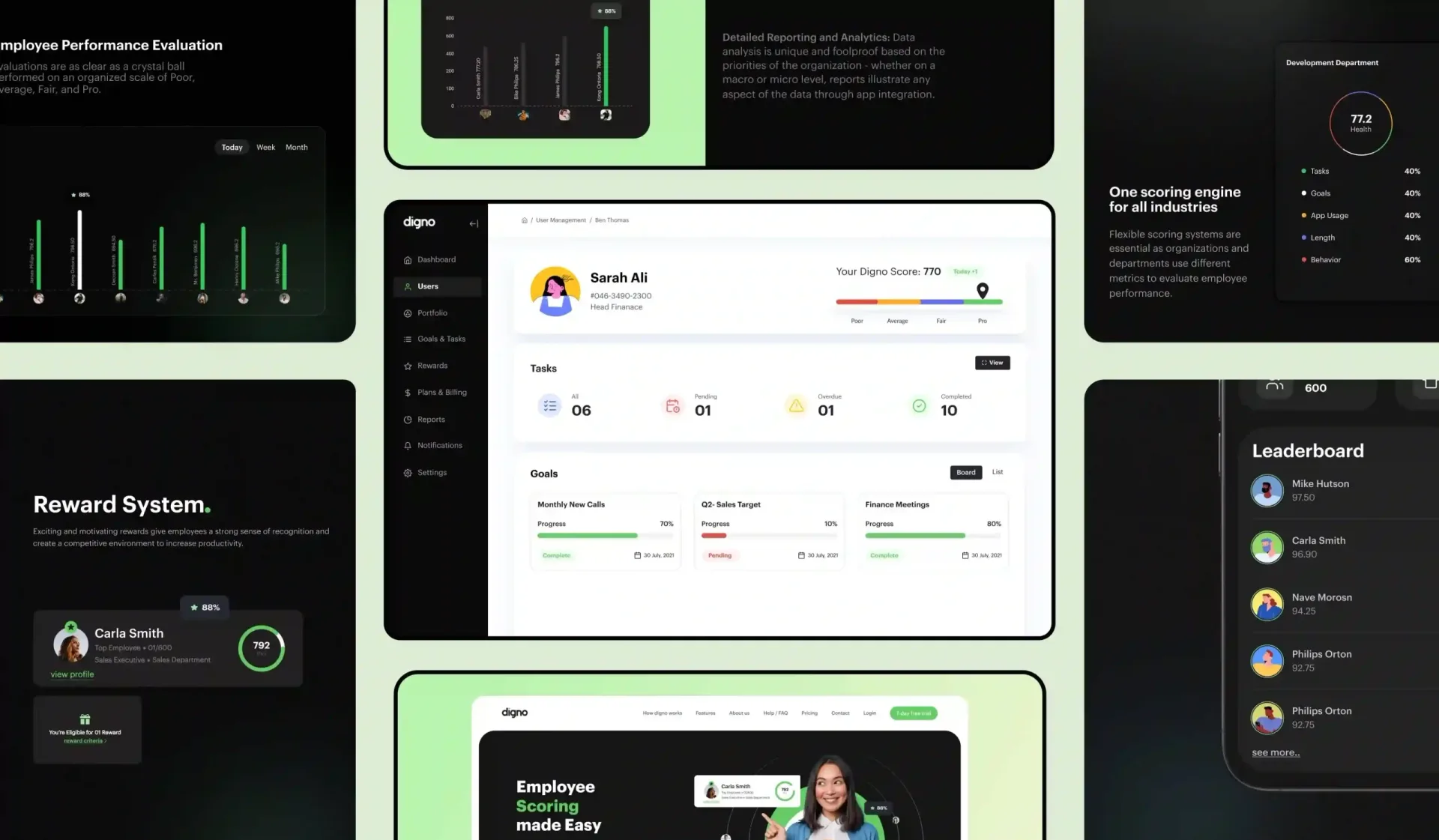
For Digno, a performance evaluation SaaS, our enterprise software UX design presents people and goals at organization, department and employee level, from one organization dashboard to each employee's own score. Each level of that organization hierarchy has its own score module.

Executives and managers had several tools but no central view of people and projects, and the product had to fit the MBO, KPIs and OKRs organizations already run. Requirements from stakeholders and users defined how the Digno score is worked out, and we designed the central platform where managers see it in three modules: organization score, department scoring and individual employee scoring. Department pages summarize goals assigned, completed and pending, and a mobile app keeps employees close to their goals. See the Digno case study.

Process

How does our enterprise UX design agency run a project?

Our enterprise UX design services run full enterprise product design in 5 steps over 8–16 weeks (40–80 working days), from a discovery workshop to the developer handoff of complex workflows.

5–10 days

Discovery and product strategy

A discovery workshop brings stakeholders from each department together to map the jobs each department needs done and agree on how success is measured, such as time on task. Teams weighing the cost can first read whether a discovery phase is worth it.

5–15 days

User research

We hold user interviews with 5–8 users per user group, such as order takers and sales managers, and watch them work in the tools they use today, following the method of our UX research services.

5–10 days

Information architecture and flows

Designers chart each role's path through the workflow, including approval steps, hand-offs between roles and the error path when a request is rejected.

10–20 days

Prototype and validation

In the prototype rounds, 5 users per round complete tasks such as approving a customer order in a clickable prototype on Maze, and we record a System Usability Scale (SUS) score after every round.

15–25 days

UI design and handoff

Our accessibility level for daily-use tools is Web Content Accessibility Guidelines (WCAG) 2.2 level AA, applied to every screen. The developer handoff gives your engineers annotated Figma files, design tokens and component specs, and our designers remain on call to them until launch.

Comparison

Enterprise UX design agency vs in-house design team

An enterprise UX design company brings a senior team for a fixed scope and a developer handoff on enterprise software; an in-house design team owns one product long term. The table sets both options side by side. When you shortlist, compare enterprise UX design agencies on two selection criteria: published prices and named enterprise work.

Comparison of a design agency and an in-house design team for internal tools
CriterionDesign agency (us)In-house design team
Best forA redesign, a new internal tool or a backlog of workflows that needs senior designers nowContinuous work on one of your enterprise products after launch
Team2–4 designers in a design sprint, 3–6 in full enterprise product designThe designers you recruit and manage
StartAfter a free consultation and a fixed-scope proposalAfter you recruit, hire and onboard each designer
CostPublished ranges, from $25,000–$60,000 for a sprint to $60,000–$180,000 for a full projectSalaries, benefits and tools for each designer
Research and testingIn full enterprise product design, 5 users per round on Maze, with a SUS score for each roundSet by the research skills and time your team has
Ongoing workAn embedded design team of 2–5 designers at $15,000–$40,000 per monthYour team keeps the component library and the product roadmap
Pricing

How much does an enterprise UX design agency cost?

Our enterprise UX design services cost $60,000–$180,000 for full enterprise product design over 8–16 weeks, or $25,000–$60,000 for a 4–8 week design sprint that can cover one of your complex workflows.

The full product design price moves with platforms (web and mobile count as two), the number of user groups (order takers, sales teams and managers make three), core user flows like taking a customer order or approving a campaign, and how many validation rounds you run. For a tool already in daily use, a UX audit of enterprise software takes 2–3 weeks and costs $5,000–$15,000 through our UX audit services. Price your first workflow against the sprint range before you compare quotes.

Typical investment$60,000–$180,0008–16 weeks
  • Internal operations platforms
  • Approval workflows
  • Performance and goal management systems
  • Enterprise dashboards
Get a free quoteEstimate your scope with the free website design cost calculator →
Standards & compliance

Which standards shape enterprise UX design?

Four standards and guidelines shape enterprise software UX design on our projects, and each one changes how employees work in their internal tools. Security and legal sign-off stay with your own teams.

  • WCAG 2.2 level AA: daily users get full keyboard access, a visible focus indicator and 4.5:1 contrast for normal-size text, and success criterion 2.2.1 Timing Adjustable requires that users can turn off, adjust or extend a time limit the content sets, so the long approval forms we design warn before they time out and offer more time.
  • From the International Organization for Standardization (ISO), ISO 9241-210 describes human-centred design for interactive systems in four activities: understand the context of use, specify user requirements, produce design solutions and evaluate the designs against those requirements. Our five steps follow that loop, from the discovery workshop to SUS-scored prototype rounds.
  • ISO 9241-110 sets interaction principles such as self-descriptiveness, controllability and use error robustness, so approval screens state where a request stands, let users undo a step and catch an error before it is submitted.
  • The National Institute of Standards and Technology (NIST) covers reauthentication and inactivity timeouts for login sessions in NIST SP 800-63B, so we design session-timeout warnings and reauthentication screens that keep unsaved work.

Not sure where your design problems actually start?

Book a 45-minute UX audit session. We review your product and identify the top three friction points.

Book a UX audit
FAQ

FAQs about hiring an enterprise UX design agency

Seven answers explain how our enterprise UX design company handles enterprise software: what enterprise UX means, hiring cost, service design, artificial intelligence (AI), code, live redesigns and in-house teams.

Still have a question?

A design lead answers every message within one business day.

Talk to a design lead
What does enterprise UX mean?

Enterprise UX is the user experience of software that people use for their work inside an organization, such as order, approval, human resources (HR), reporting and admin tools, where success means fewer errors and less time per task rather than delight. In UX, the word enterprise names that setting, a large organization and its own staff, not a pricing tier. It differs from consumer UX because employees must use the tool and several roles share one workflow.

How much does it cost to hire a UX designer?

Through us, hiring UX designers costs from $5,000–$15,000 for a 2–3 week UX audit to $15,000–$40,000 per month for an embedded design team of 2–5 designers, and full enterprise product design runs $60,000–$180,000 over 8–16 weeks. For in-house pay, the US Bureau of Labor Statistics publishes current wage figures for web developers and digital designers in its Occupational Outlook Handbook.

What is UX service design?

Service design plans the people, processes and back-office steps behind a screen, not only the screen: the frontstage that customers see and the backstage that makes it work. At Mass Media Co., the client wanted both its order process and its systems revamped, and the case calls the work a full process transformation. We map frontstage and backstage as part of our design work, and our UX consulting services review the product, its analytics and the design process behind it.

Will AI replace enterprise UX design?

No. We use AI to move production work faster, while research with the employees who run the tool and patterns from 200+ products decide what we design. Internal tools hide workarounds and approval rules that surface when you interview and observe the people who use them.

Do you build the enterprise tools or connect them to other software?

No. Our enterprise UX design agency delivers annotated Figma files, design tokens and component specs; your engineers build the software and connect it to enterprise resource planning (ERP), customer relationship management (CRM) and identity platforms. Our designers keep answering engineering questions until the tool launches.

Can you redesign an enterprise tool that teams use every day?

Yes. The low-risk first step is a UX audit of the live tool, 2–3 weeks for $5,000–$15,000, whose prioritized fix list shows which workflow to fix first, and a $25,000–$60,000 design sprint can redesign that workflow. A phased release starts with the most-used workflow, and each later release adds one more, so employees learn one changed workflow at a time.

Can you work with our in-house design team and design system?

Yes. An embedded design team of 2–5 designers joins your product and engineering sprints for $15,000–$40,000 per month and works inside your design system, the shared library of components and rules your products use. When that library needs governance across departments, our design system services set up the model.

Ready to launch faster and convert more users?

Send us your project. A design lead reviews it and schedules a call within one business day. We sign an NDA before the first technical discussion if you prefer.