Key takeaways
- Contextual inquiry is a generative UX research method: you watch users do real work in their own setting and ask about each step as it happens.
- Its four principles are context, partnership, interpretation and focus.
- A session runs about 2 hours in four parts: session primer, transition, contextual interview and wrap-up.
- Observation catches the tacit steps, workarounds and interruptions that users leave out when you only ask them.
- Field notes become design decisions in an interpretation session of 3–8 people, then an affinity diagram and work models.
Ask a warehouse receiving clerk how she checks in a delivery and she says "scan the pallet, confirm the count, done"; watch her during a contextual inquiry and you see a paper packing list, a second screen for the purchase order, a call to the buyer and a sticky note on a damaged carton. The clerk is an illustrative composite, not a client, but the gap between what people say and what they do is the reason the method exists.
This said versus did gap is why user experience (UX) researchers watch users work in their real work setting and ask why at natural pauses, instead of trusting what people report. Running it well takes four principles, a 2-hour session plan, questions tied to what the user just did, a field-note sheet and a way to turn notes into design decisions, and each gets its own section here. It is also one of the six deliverables in our UX research services, and we run it on-site.
What is contextual inquiry?
Contextual inquiry is a generative research method in which a researcher observes users doing real work in their own work setting and asks about each step as it happens.
It sits in the discovery half of UX research, before any screen exists. Karen Holtzblatt and Hugh Beyer made it the field step of Contextual Design, a user-centered design methodology published as a book in 1997, as the Wikipedia entry on the method records. Nielsen Norman Group (NN/g) calls it a type of ethnographic field study in which researchers observe and interview users in depth.
The master-apprentice model sets the roles: the user is the expert, and the researcher learns the job like an apprentice, by watching and asking. One visit with one user is a session, a study is a set of contextual inquiries, and many teams call the method field observation.
What does contextual mean in simple terms?
In everyday English, contextual means depending on the surrounding situation; in contextual research with users, it means the real work setting around the task being observed.
The contextual factors are the place, the tools and artifacts, the other people, the interruptions and the time pressure: for the clerk, a loud dock, a scanner, the buyer and a waiting truck. In UX research, contextual analysis is the interpretation step that turns observations into patterns, such as the warehouse cluster "clerks cannot see the expected quantity" in the section on turning field notes into design decisions. List the contextual factors around your product's main task before you plan a visit.
Why does contextual inquiry beat asking users what they do?
Field observation beats asking because watching users in the real work setting records what they do, while an interview records what they remember and choose to say.
Three causes open the gap between what users say and what they do:
- Tacit knowledge. Experts automate steps they no longer notice, and Wikipedia notes the method reveals work knowledge users are not consciously aware of. Their mental models hold the steps they think about, not the ones their hands perform.
- Recall. Asked about a typical day, people describe the rule, not the last real instance, so self-reported behavior smooths over interruptions.
- Social desirability bias. People describe the correct procedure, because a sticky note or a call that skips the system looks like breaking the rules.
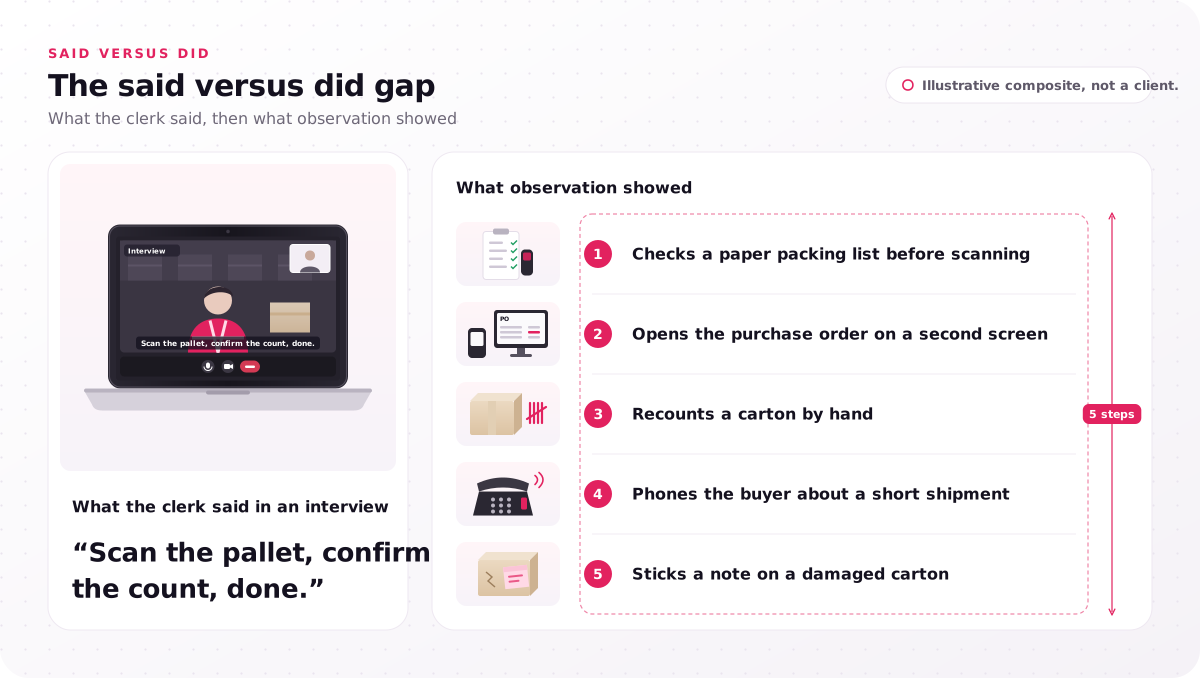
| What the clerk said in an interview | What observation showed |
|---|---|
| "Scan the pallet, confirm the count, done." | 1. Checks a paper packing list before scanning |
| 2. Opens the purchase order on a second screen | |
| 3. Recounts a carton by hand | |
| 4. Phones the buyer about a short shipment | |
| 5. Sticks a note on a damaged carton |
Illustrative composite, not a client.
Observation changes behavior too: under the Hawthorne effect, people act differently while watched. Nikki Anderson, writing for dscout's People Nerds, counters it with rapport, longer sessions and a reminder that you are evaluating the product, not them. Our practitioner view is that real deadlines limit it further: a truck waiting at the dock pulls the clerk back to her usual shortcuts. If your evidence is all self-report, plan one observed session before you design.
What are the four principles of contextual inquiry?
The four principles are context, partnership, interpretation and focus, and together they stop field observation in the real work setting from turning into a plain interview.
Holtzblatt and Beyer set the principles, and NN/g's Kim Flaherty restates them in her 2020 guide. The "mistake it prevents" column is our framing.
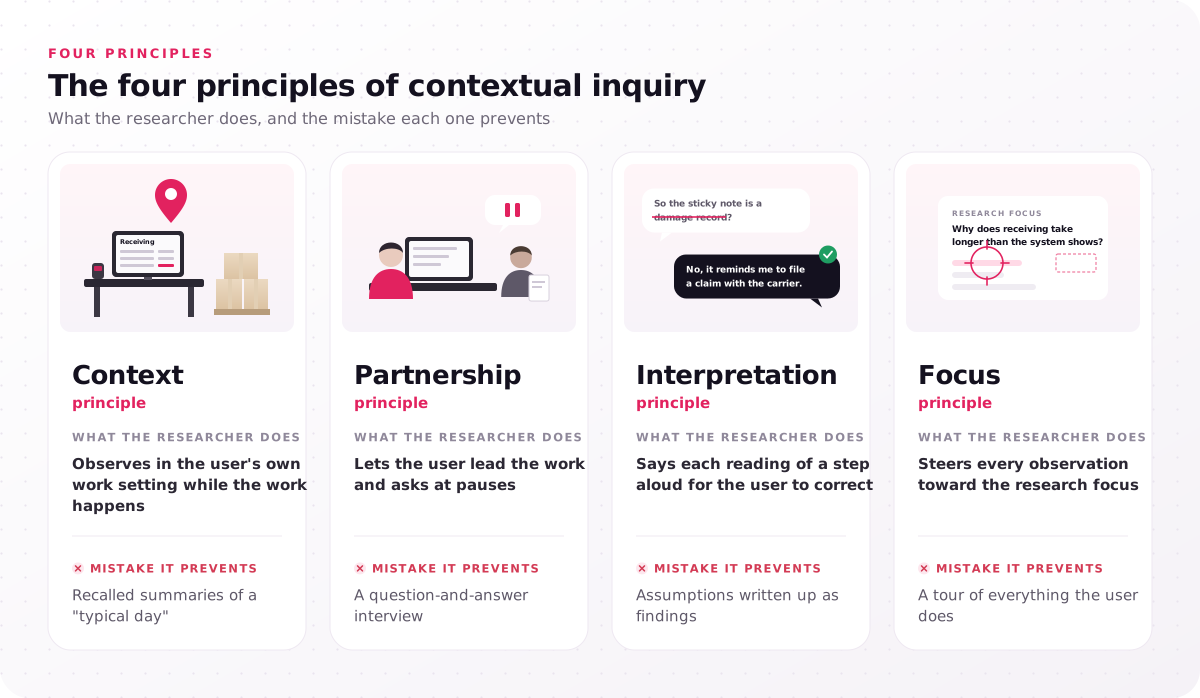
| Principle | What the researcher does | Mistake it prevents |
|---|---|---|
| Context principle | Observes in the user's own work setting while the work happens | Recalled summaries of a "typical day" |
| Partnership principle | Lets the user lead the work and asks at pauses | A question-and-answer interview |
| Interpretation principle | Says each reading of a step aloud for the user to correct | Assumptions written up as findings |
| Focus principle | Steers every observation toward the research focus | A tour of everything the user does |
The interpretation principle builds shared understanding, because the user fixes your reading on the spot. The research focus is the product team's one question, unrelated to a focus group, where several people discuss opinions; without it, a session drifts into a complaint session. Write your research focus as one sentence before you recruit anyone.
How does contextual inquiry compare with other methods?
Contextual research combines observing and interviewing users in the real work setting, while user interviews rely on recall, usability testing watches set tasks, and ethnography studies whole cultures.
The table compares the four methods by setting, data, sample and output.
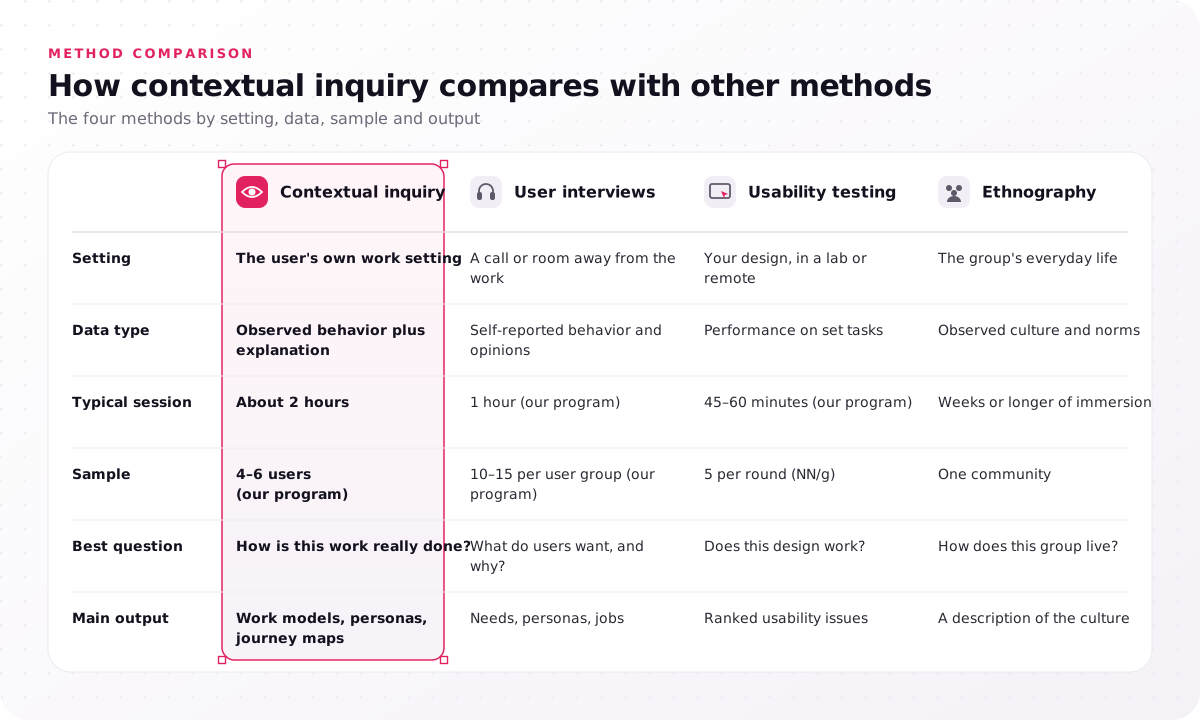
| Contextual inquiry | User interviews | Usability testing | Ethnography | |
|---|---|---|---|---|
| Setting | The user's own work setting | A call or room away from the work | Your design, in a lab or remote | The group's everyday life |
| Data type | Observed behavior plus explanation | Self-reported behavior and opinions | Performance on set tasks | Observed culture and norms |
| Typical session | About 2 hours | 1 hour (our program) | 45–60 minutes (our program) | Weeks or longer of immersion |
| Sample | 4–6 users (our program) | 10–15 per user group (our program) | 5 per round (NN/g) | One community |
| Best question | How is this work really done? | What do users want, and why? | Does this design work? | How does this group live? |
| Main output | Work models, personas, journey maps | Needs, personas, jobs | Ranked usability issues | A description of the culture |
User interviews are a semi-structured interview away from the work: quick to schedule and good for motivations, but every answer passes through memory. Our Mass Media Co. platform revamp listed user interviews in its scope, next to a discovery workshop with stakeholders and users that covered information architecture and user flows. Usability testing is evaluative and checks a design you already have, the job of our usability testing services. Pick the column whose best question matches yours.
What is the difference between contextual inquiry and ethnography?
The difference is scope: this method is a focused, shorter form of ethnographic field study, observing users in their real work setting for hours, not weeks, around one design question.
Ethnography comes from anthropology and describes a whole culture, usually with no product decision in mind. Contextual research borrows its fieldwork, adds an interview and drops everything outside the research focus. Choose ethnography for a community's life, and field observation with interviews for a job your product supports.
When should you use contextual inquiry, and when not?
Use field observation in early discovery, when your team cannot yet describe how users do complex, expert or physical work in their real work setting.
The method fits these situations:
- Complex or expert work (enterprise software, clinical work, logistics), because much of an expert's routine is tacit knowledge they leave out when describing it. Our supply chain UX design process includes a floor-observation step in which researchers shadow pickers and dispatchers across shifts and record scan sequences and interruptions.
- Work shaped by the room or other people, such as a hospital ward, because interruptions and external resources only show up on site. Our process for healthcare products includes a clinician-shadowing step with nurses and physicians.
- Drop-off in analytics with no known reason, because numbers show where users leave and observation shows why.
- A new market, because your team's mental models of the job no longer apply.
It is the wrong method in these cases:
- Menu labels or navigation, because card sorting and tree testing answer information architecture questions faster.
- A single simple task, such as a password reset, because a short usability test covers it.
- Numbers across many users, because a small sample gives no percentages; use a survey or analytics.
- No access to the real setting, because the session becomes an interview; run user interviews and say so.
If your product matches the first list, schedule observed sessions before the first wireframe. If it matches the second, choosing between UX research methods by the question you need answered points to the better fit.
How do you conduct a contextual inquiry?
Each field observation session runs about 2 hours in the user's real work setting and has four parts: session primer, transition, contextual interview and wrap-up.
Prepare four things before the visit:
- Write the research focus as one sentence, for example "Why does receiving take longer than the system shows?"
- Recruit 4–6 users, our program's figure (the FAQs give Holtzblatt's wider range).
- Agree site access and recording consent: informed consent for audio, video and photos, and what stays off camera, such as screens with customer data.
- Pair an interviewer with a note-taker, who writes the field notes.
The session structure below is an example plan for a 2-hour visit.
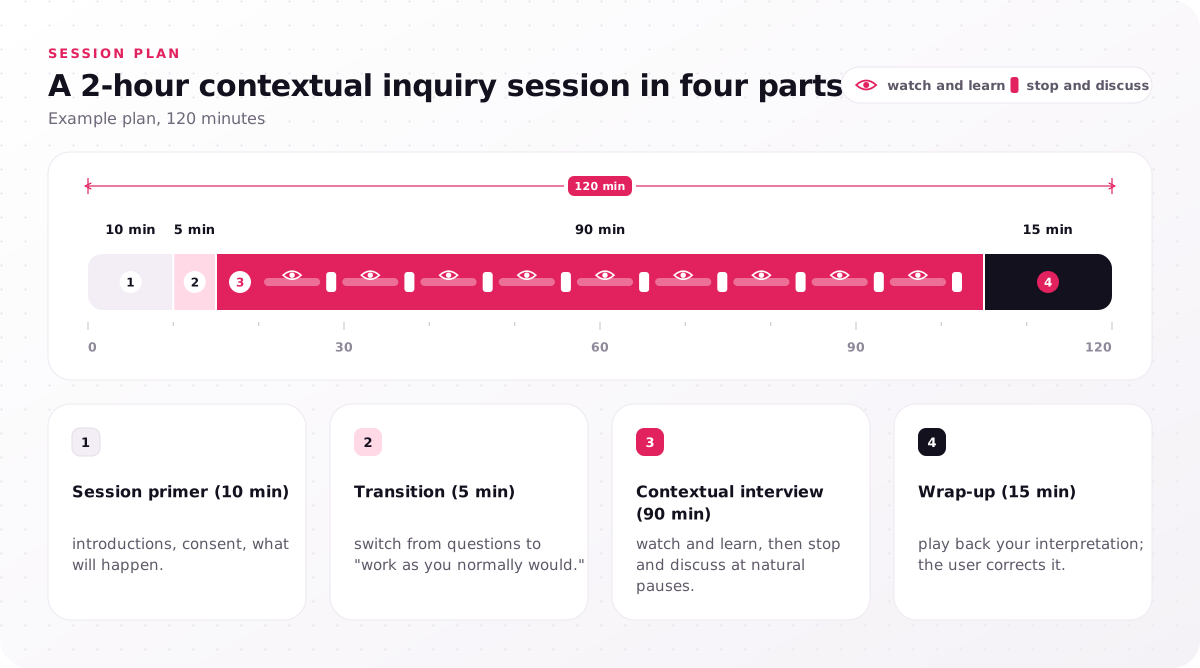
Example plan, 120 minutes:
- Session primer (10 min): introductions, consent, what will happen.
- Transition (5 min): switch from questions to "work as you normally would."
- Contextual interview (90 min): watch and learn, then stop and discuss at natural pauses.
- Wrap-up (15 min): play back your interpretation; the user corrects it.
The contextual interview follows NN/g's loop: watch and learn, then stop and discuss when the user does something you do not understand. Pick the inquiry mode in advance: in active inquiry the user answers questions while working, and in passive inquiry, as dscout describes it, you only observe and ask at the end, which suits safety-critical work such as a forklift run.
Three risks need a fix in the room: interview mode, where users summarize instead of working (ask them to carry on); observer bias, reading your assumptions into what you see (the wrap-up playback catches it); and a complaint session (ask "Show me the last time that happened").
Site access, consent and recruiting are where in-house studies stall, so our program gives participant recruitment its own step of 3–6 days. Book the site visits before you write the question bank.
Which contextual inquiry questions should you ask?
Good contextual interview questions point at what the user just did in the real work setting: "What made you open that second screen?" beats "How do you usually check orders?"
Group the question bank by session moment:
- Opening: "What does your role cover on a normal shift?" "Which part of today's work should I watch most closely?"
- During observation: "What were you checking just then?" "What happens if you skip that step?" "Is today a normal day, or is something different?"
- Workarounds and external resources: "Where did that number come from?" "Who wrote this sticky note?" "When did you start keeping that list?"
- Wrap-up: "Here is what I think happened; what did I get wrong?" "Which step did I not see today?"
Three question types to avoid, with a better version:
- Leading: "Isn't the scanner slow?" becomes "Talk me through what happened while you waited."
- Hypothetical: "Would you use a feature that…?" becomes "Show me the last time you needed that."
- Future preference: "What would you want in the new app?" becomes "What did you do the last time the count was wrong?"
A contextual inquiry template for field notes
Field notes from each observation session work best as one row per observed step, with columns for the workaround seen and the question for the next pause.
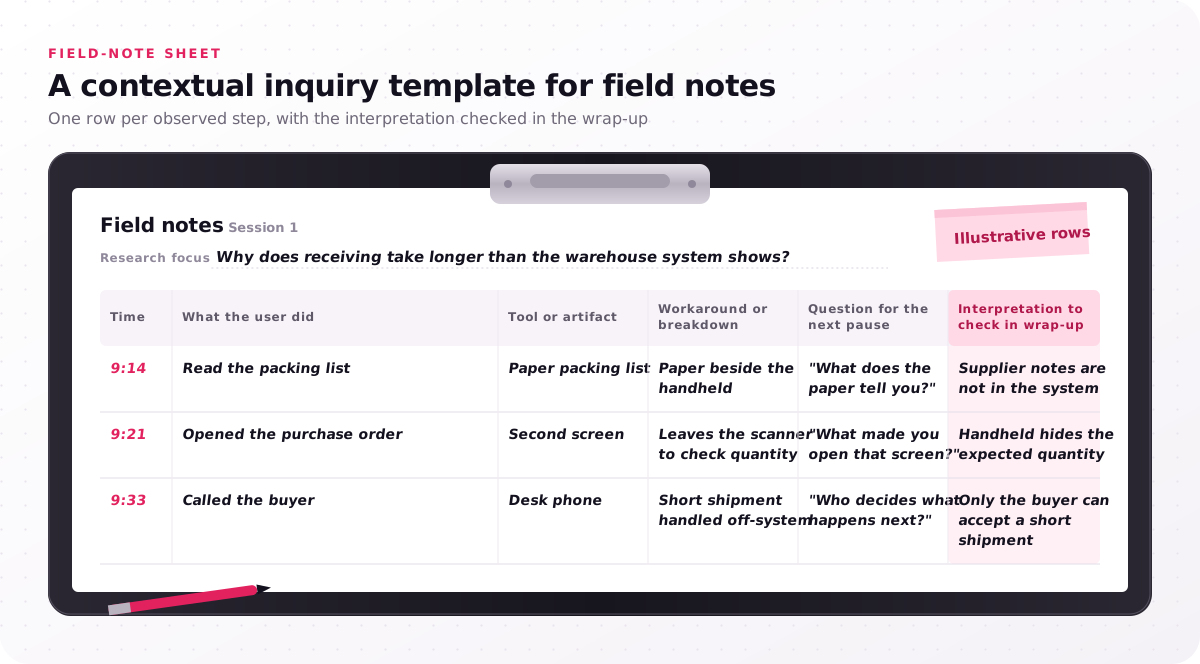
Illustrative rows:
| Time | What the user did | Tool or artifact | Workaround or breakdown | Question for the next pause | Interpretation to check in wrap-up |
|---|---|---|---|---|---|
| 9:14 | Read the packing list | Paper packing list | Paper beside the handheld | "What does the paper tell you?" | Supplier notes are not in the system |
| 9:21 | Opened the purchase order | Second screen | Leaves the scanner to check quantity | "What made you open that screen?" | Handheld hides the expected quantity |
| 9:33 | Called the buyer | Desk phone | Short shipment handled off-system | "Who decides what happens next?" | Only the buyer can accept a short shipment |
The last column matters most: each interpretation is checked in the wrap-up, so the notes carry the user's correction, not your guess. Copy sticky notes or printouts only with permission, with customer data covered. Print the sheet before your first visit.
Contextual inquiry example, a warehouse receiving study
This contextual inquiry example follows an illustrative study of warehouse receiving clerks, where watching them in the real work setting showed steps none of them mentioned when asked.
Every detail is invented; no client is described. The research focus was "Why does receiving take longer than the warehouse system shows?", with 5 sessions at 2 sites, in active mode except during forklift unloading.
Session 1 produced the three rows on the field-note sheet above, each answered at the next natural pause; the paper turned out to carry supplier notes about substituted items. A habit became a pattern only when it repeated: clerks at both sites opened the purchase order on a second screen, and none had mentioned it when asked how receiving works.
In the wrap-up, the researcher read the sticky note as a damage record, and the clerk corrected it: the note reminds her to file a claim with the carrier.
The study ends with three design questions: should the handheld show the expected quantity, does a short shipment need its own flow with the buyer's approval, and where should a carrier claim start? Write your own study's questions in this form before synthesis.
How do you turn field notes into design decisions?
After field observation, the team turns field notes from the real work setting into decisions in an interpretation session, then groups the insights in an affinity diagram.
- Hold an interpretation session soon after each visit, while the observations are fresh, with an interpretation team of 3–8 people (Wikipedia's range for Holtzblatt's method); the researcher retells the session and the group writes one insight per note.
- Group notes from all sessions in an affinity diagram, by user problem, not by screen.
- Draw work models such as flow and sequence models, which show who hands what to whom and in which order.
- Turn the clusters into personas, a journey map per persona and a Jobs to be Done opportunity map that ranks user jobs.
A journey map lays out one persona's steps, emotions and pain points over time, and our customer journey map template shows how observed steps fill its Doing and Touchpoints lanes. In the warehouse example, the cluster "clerks cannot see the expected quantity" becomes a decision: show it on the handheld.
Synthesis is where notes pile up and nobody owns the readout. In our program, synthesis and readout is a step of its own (4–7 days): findings are tagged in Dovetail and presented in a 90-minute readout. Book the interpretation sessions when you book the visits.
What does contextual inquiry take, and who should run it?
A contextual research study takes travel to the real work setting, about 2 hours per user plus interpretation time, and 4–6 users in our program.
The FAQs list the benefits; the limits are these:
- Resource cost: travel, a few hours with each user and more hours to interpret, as Wikipedia notes.
- A small sample, so findings explain behavior but do not measure it.
- Access, since sites with customer data or safety rules need approval first.
Fieldwork in our UX research program lasts 7–15 days inside a 4–8 week engagement priced at $25,000–$60,000, and on-site contextual inquiry is one reason a program lands near the top of that range. The UX research pricing examples show what a program at each end of it includes.
Bring in a research team when nobody in-house has time to arrange site visits, consent and recruiting, when you cannot spare people for 7–15 days of fieldwork, or when you need personas and journey maps your product team will use. If you plan to outsource, read how to compare research agencies before you hire one.
Contextual inquiry earns its travel cost only when the answer lives in the work itself, not in what people remember about it. If you cannot tell which kind of question you have, tell us what you need to learn about your users and we will name the method that fits, observation or not. Every project begins with a free consultation and a fixed-scope proposal.
FAQs
How many participants does a study need?
Our program sets a participant count of 4–6 users. Holtzblatt's guidance, as Wikipedia reports it, runs from as few as 4 users for a single, small task to 30 or more, and NN/g's Mayya Azarova splits the count into users per visit, visits per day and total visits.
How long does one session take?
The session length is about 2 hours per user in Holtzblatt's method. NN/g puts the range at an hour or two up to several days of observation, depending on scope.
Can contextual inquiry be done remotely?
Yes, for screen-based desk work. NN/g's Kate Kaplan calls it semicontextual inquiry, since only the user is in context, and advises screen sharing of the entire desktop, the researcher's camera off while observing and a remote session cap of 2–3 hours. It misses physical work, so our program runs it on-site.
What is the primary objective of contextual inquiry?
The primary objective is to understand how users really do their work, including the tacit steps and workarounds they cannot report. The product team then designs for the workflow that exists, not the one in the manual.
What are the benefits of contextual inquiry?
It replaces recall with observed behavior and surfaces the tacit knowledge and workarounds that surveys miss. Its findings are tied to real tasks, and stakeholders who watch a clip of a user at work argue less from opinion.
Is a contextual interview the same as contextual inquiry?
No, not exactly. In UX research, the contextual interview is the central part of each observation session with users, the watch-and-ask loop, though many teams use the terms interchangeably. In clinical psychology, "contextual interview" names an unrelated technique.