5–10 days
UI inventory and audit
We collect every screen, list duplicate patterns and agree the products and platforms in scope.

Development-ready component libraries, design tokens, and documentation so teams ship consistent UI without waiting on designers.





Get a free consultation
Free consultation · reply within one business day
In shortDesign system services build a shared set of design tokens, a development-ready component library and usage documentation so every product team ships a consistent user interface (UI). Our design system engagement takes 8–16 weeks, costs $60,000–$180,000, and ends with a Figma library, tokens in code and a governance model.
A design system is a single source of truth for a product's user interface: design tokens, reusable components, usage guidelines and the governance rules that keep them current. Designers use the Figma library and engineers use the matching coded components, so both teams build from the same parts.
A design system differs from a style guide in one way: a style guide documents colours and type, while a design system also ships working components and a process for changing the components. Our design system services follow Atomic Design, from tokens to atoms, molecules and templates, and include the component states defined by an interaction design agency.
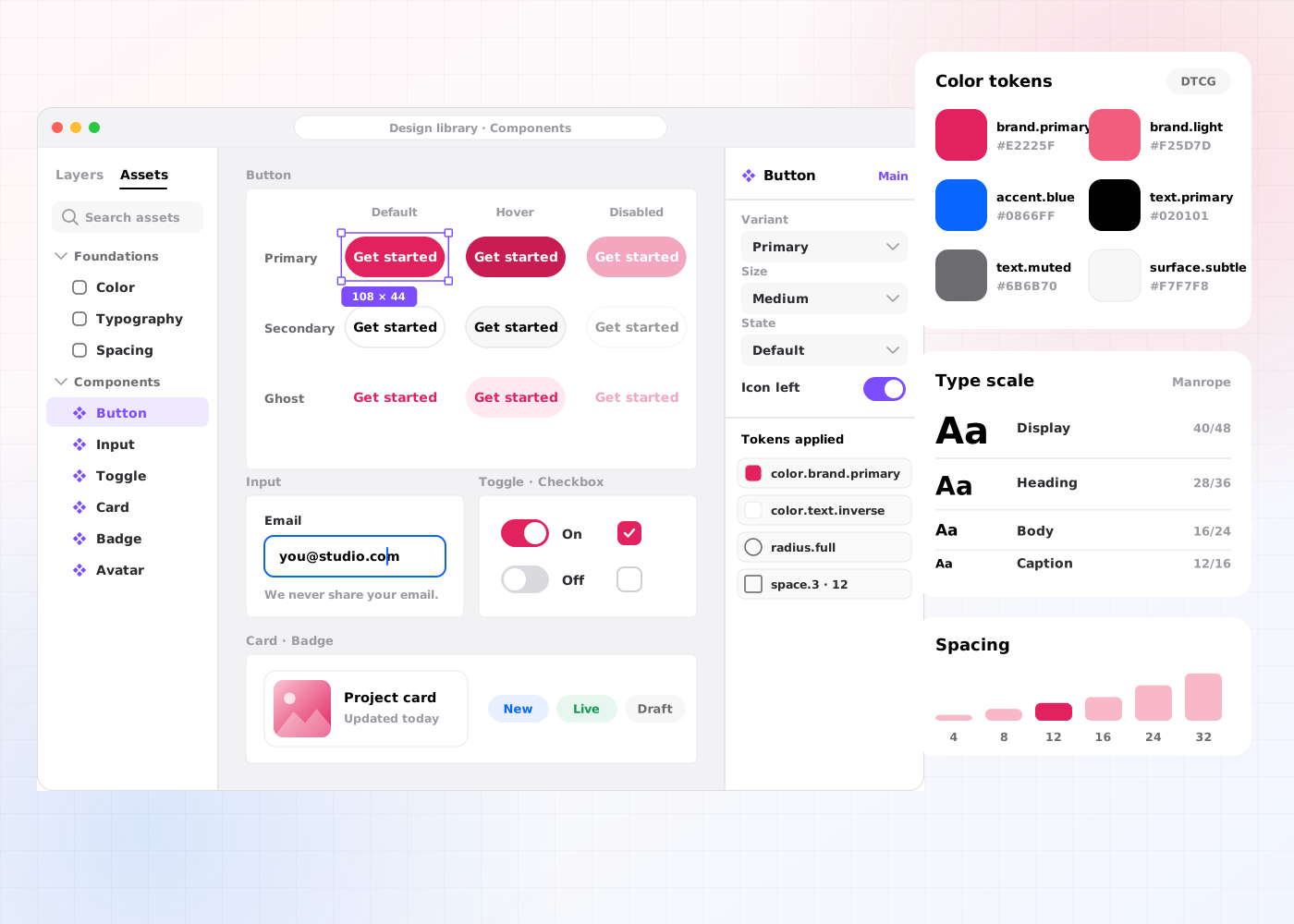
Our design system services include 6 deliverables: a UI inventory, design tokens, a Figma component library, a coded component library, design system documentation and a governance model.
Every existing screen is captured and grouped, for example duplicate button styles, colour values and spacing values.
Colour, typography, spacing, radius and motion values are stored as tokens in the Design Tokens Community Group (DTCG) format, for example color.text.primary.
Components use variants, auto layout and variables, for example buttons, inputs, modals and data tables.
Components are built with the client's engineers and documented in Storybook, for example with visual regression tests in Chromatic.
Each component page in Zeroheight or Storybook lists anatomy, states and accessibility rules, for example the Web Content Accessibility Guidelines (WCAG) 2.2 contrast ratio of 4.5:1 for body text.
A contribution process defines who proposes, reviews and releases changes, for example a monthly release with semantic versioning.
The design system process takes 8–16 weeks (40–80 working days) and runs in 5 steps, from UI inventory to governance handover.
We collect every screen, list duplicate patterns and agree the products and platforms in scope.
Designers define colour, typography, spacing and elevation tokens, managed in Tokens Studio and exported to code with Style Dictionary.
Designers build each component in Figma with variants and states, starting with the most used components, for example buttons, inputs and navigation.
Engineers match each Figma component to code in Storybook, and designers write usage guidelines and accessibility rules per component.
We set up design system governance, train product teams in 2 workshops and release version 1.0 of the design system.
A design system has 4 benefits: it increases component reuse rate, improves UI consistency, reduces design and development time and develops design maturity.
Teams pick existing components from the Figma and Storybook libraries instead of building new ones, which increases the share of screens built from shared parts.
Shared tokens and components improve consistency of colour, spacing and behaviour across every product, platform and team.
Designers assemble screens from ready components and engineers reuse tested code, which reduces the time from design to release. To put a dollar figure on those saved hours before you fund the build, run the payback model in our design system ROI guide.
The governance model develops a shared design practice, with product teams contributing components through one review process.
A design system includes tokens, components, code, documentation and governance; a UI kit includes only the visual components in a design file. Teams with 1 product and 1 designer start with a UI kit, and teams with several products need a design system.
| Criterion | Design system | UI kit |
|---|---|---|
| Contents | Tokens, components, code, documentation and governance | Visual components in Figma |
| Code alignment | Matching components in Storybook | None |
| Maintenance | Governance model and versioned releases | Manual updates by 1 designer |
| Timeline | 8–16 weeks | 2–4 weeks |
| Price on this site | $60,000–$180,000 | Part of a $25,000–$60,000 design sprint |
Related:dashboard design servicesdigital product design services
A design system costs $60,000–$180,000 and takes 8–16 weeks. The price depends on 4 factors: the number of components, the number of platforms, the number of brands or themes and the depth of code alignment.
A single-brand web design system with 25–30 components, a Figma library and Storybook documentation sits near $60,000. A multi-brand design system with light and dark themes, 60–80 web and mobile components and a governance rollout sits near $180,000. Teams that maintain the design system after release book an embedded user experience (UX) design team for $15,000–$40,000 per month through UX consulting services.
A growing product team needs design system services in 5 situations:
Book a 45-minute UX audit session. We review your product and identify the top three friction points.
Book a UX auditWe design UI and UX for SaaS, E-commerce and Enterprise products.
Send us your project. A design lead reviews it and schedules a call within one business day. We sign an NDA before the first technical discussion if you prefer.
These answers cover the 5 questions buyers ask most about design system services.
Still have a question?
A design lead answers every message within one business day.
Talk to a design leadYes. Our design system includes coded components documented in Storybook, built with the client's engineers to match the Figma library 1:1.
Yes. A design system for an existing product starts with a UI inventory and replaces duplicate patterns screen by screen, without a full redesign.
A design system uses Figma for the design library, Tokens Studio and Style Dictionary for design tokens, and Storybook for coded components.
No. A startup with 1 product and 1–2 designers needs a UI kit and design tokens first; a full design system fits when 2 or more teams build on the same product.
A design system takes 8–16 weeks, which equals 40–80 working days, from UI inventory to the version 1.0 release.