5–10 days
Discovery and product strategy
Stakeholder interviews set the core loop, target audiences and success metrics. Our guide shows what a discovery phase settles before screens.

Our game UI/UX design services plan and design the screens players touch: the heads-up display (HUD), menus, onboarding, inventory, in-game store and the game website. One senior team takes a game studio from concept to playtested, engine-ready Figma designs.





Get a free consultation
Free consultation · reply within one business day
In shortGame UI/UX design services shape the user interface (UI) and user experience (UX) of a video game, from the HUD to the in-game store and the game website. They are part of our digital product design services. A full game engagement runs 8–16 weeks, costs $60,000–$180,000, and ends with playtested Figma designs the studio's engine team implements.
Game UI/UX design services plan how players move through a video game (UX) and design the screens they see and touch (UI), from the HUD to the game website.
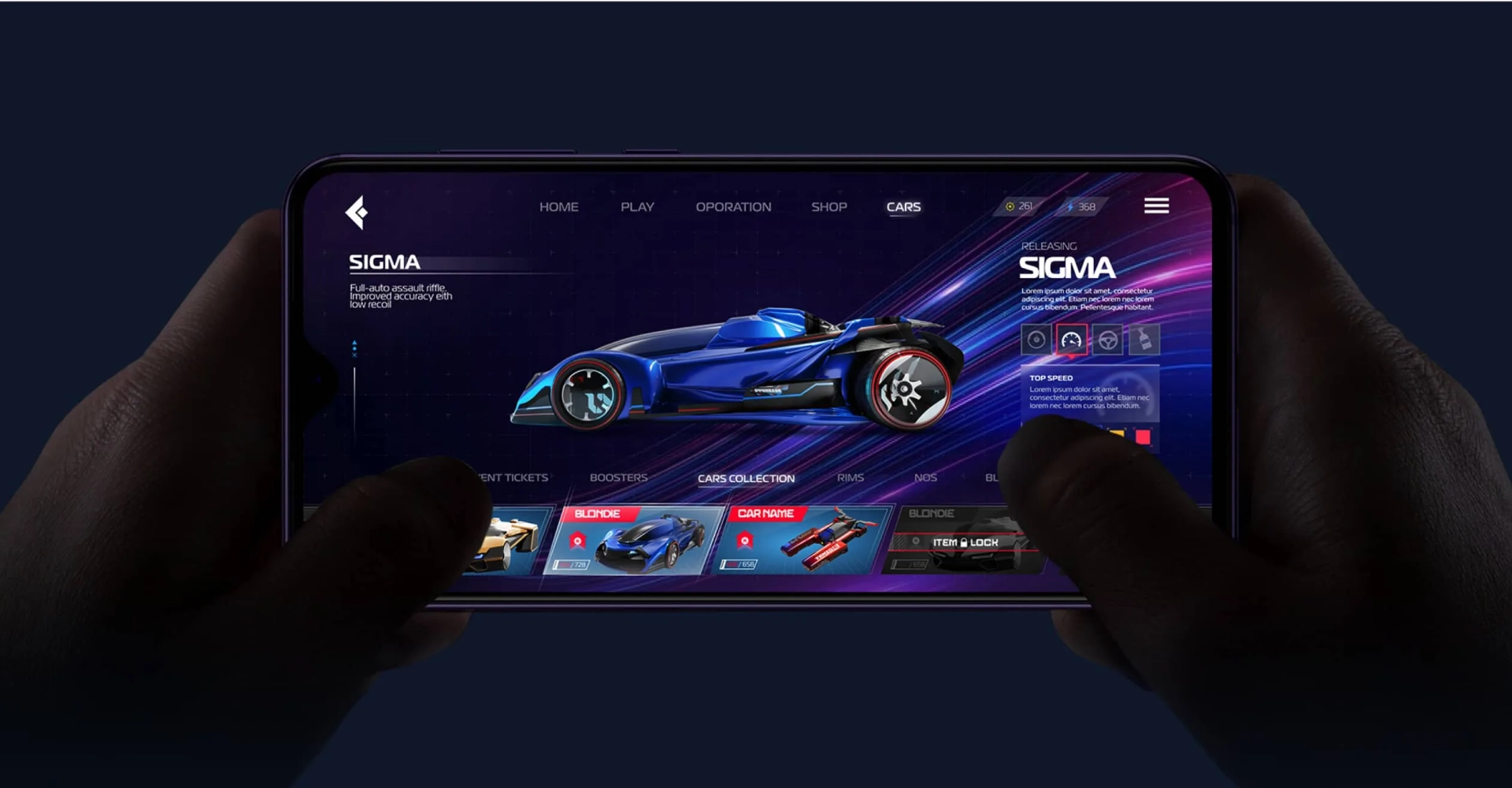
Game interface design is part of our digital product design services and draws on the senior team behind our UI UX design services. As a game UI design agency we deliver annotated Figma screens and component specs; the game studio's Unity engine or Unreal Engine developers build them. The Nitro League garage screen shows that output on mobile.
Our game interface design covers 6 parts of a video game that players touch, each drawn in every screen state: default, loading, error, empty, locked and reward.
Health, speed, map and timers stay readable at a glance during motion. Video game UI design services for the HUD add motion and feedback, the core of our interaction design agency work.
Main menu, pause, controls remapping, audio and subtitle settings, so players find the options they expect without digging through nested menus.
The first session, from launch to the first win, teaches controls inside gameplay instead of a wall of tutorial text.
Players compare, upgrade and equip items, as in the 3D garage we designed, where Nitro players inspect, upgrade and show off their race cars.
Currencies, bundles and the battle pass get clear prices, and loot box odds appear before purchase, as Apple and Google Play require.
Roadmap and whitepaper pages explain non-fungible tokens (NFTs) and lead players and investors into the NFT marketplace, built on our UI UX web design practice.
UI UX design for games keeps the intended challenge fun for players and removes friction everywhere else, so they struggle with the game, not the interface.
A hard race is the game working; a hidden settings menu is a defect. Playtesting separates the two by watching where players fail and asking why.
HUD text and icons need contrast and size that hold at speed, so players read health or position at a glance without looking away from the action.
Mobile game UI design sizes touch targets for thumbs: 44×44 pt on iOS and 48×48 dp on Android, as in our mobile app UI UX design services. Mobile game UX design keeps key actions in thumb reach and plans controller support.
Prices, currencies and play-to-earn (P2E) rewards must be clear enough for players and investors to believe. Nitro came to us when investors doubted crypto products, so the racing experience had to earn trust.
Our video game UX design shaped the racing game, 3D garage and NFT marketplace website for Nitro League players, and the project secured $5M in funding within 3 months.
Nitro League is a decentralized play-to-earn racing game built on upgradeable NFTs and the Nitro token, for gamers, NFT collectors and investors. Its scope: "idea to product, conceptualisation, art direction, sketching and modeling, MVP [minimum viable product] launch plan, game and website design, and post-launch enhancements." Discovery and stakeholder interviews led to user flows and a whitepaper; professional gamers validated the result. Read the Nitro League case study.
Our game UI/UX design services take a game studio from discovery to engine-ready handoff in 8–16 weeks (40–80 working days) and 5 steps.
Stakeholder interviews set the core loop, target audiences and success metrics. Our guide shows what a discovery phase settles before screens.
Researchers interview 5–8 target players per player group to find where onboarding, menus and purchases lose them.
The team maps the menus, the FTUE flow and the purchase flow before any screen is drawn.
Five players per round complete tasks in a clickable Figma prototype, the same prototype playtests our usability testing services run, so friction surfaces before engine work starts.
Designers finish the HUD and every screen state, then hand annotated Figma files, design tokens and component specs to the Unity engine or Unreal Engine team, with Web Content Accessibility Guidelines (WCAG) 2.2 level AA on web surfaces.
Game UI/UX design services decide what players need on each screen and in what order; game art production makes the characters, environments and effects. Hiring a game UI/UX design company instead of a pure art studio fits when players struggle with flows, not visuals. The table compares both disciplines.
| Criterion | Game UI/UX design | Game art production |
|---|---|---|
| Main question | What do players need on each screen, and in what order? | What do the characters, environments and effects look like? |
| Inputs | Player research, stakeholder interviews and user flows | Concept briefs, style guides and visual references |
| Outputs | Flows, clickable prototypes, UI screens and annotated specs in Figma | 3D models, textures, animation and visual effects |
| Validation | Playtests with 5 players per round on a prototype | Art reviews against the style guide |
| When to hire | Players get lost in menus, quit during the FTUE or skip the in-game store | The game needs more characters, environments or effects |
| Who does it | Our senior design team, including art direction, as on Nitro League | Your art team or an art studio; we do not sell large-scale asset production |
Game UI/UX design services cost a game studio $60,000–$180,000 over 8–16 weeks for a full product, or $25,000–$60,000 over 4–8 weeks for a UI sprint.
A full engagement uses 3–6 designers and covers game UI, website and game marketplace; a sprint uses 2–4. Price follows the number of target platforms (iOS, Android and web), player groups, core flows such as the FTUE and the in-game store, and playtest rounds. A live game with weak in-game store or FTUE conversion starts with an audit: $5,000–$15,000 over 2–3 weeks via our UX audit services.
Six platform and accessibility standards shape game UI design services for mobile and web games, and each one changes what players see on screen:
Moderated studies, concept validation, and A/B testing that catch problems before they ship.
02Strategy, UX, UI, and validation from one team that stays through launch.
03Flows, micro-interactions, states, and motion that make every action clear.
04Website UX and UI built around clear structure and conversion.
05Research-led UX and polished UI for iOS and Android apps.
06Design sprints, MVPs, and investor-ready products built fast and validated.
Book a 45-minute UX audit session. We review your product and identify the top three friction points.
Book a UX auditThese answers cover the 5 questions a game studio asks most before buying game UI/UX services.
Still have a question?
A design lead answers every message within one business day.
Talk to a design leadNo. Our designers deliver annotated Figma screens, design tokens and component specs, and the game studio's Unity engine or Unreal Engine developers build them. The specs list every screen state, so developers do not have to guess how a locked or reward screen looks.
Yes. Start with an audit of the live game, $5,000–$15,000 over 2–3 weeks, that reviews the in-game store, FTUE and menu flows against usability heuristics and analytics. Its prioritized fix roadmap then scopes a UI sprint.
Yes. A UI sprint of $25,000–$60,000 over 4–8 weeks can cover only the HUD and menus, and ends with a prototype playtested with players. Game UX design outsourcing works the same way: research, flows and playtests come to us while the game studio keeps engine implementation in-house.
Yes. Mobile game UI design follows the Apple Human Interface Guidelines and Google Play policies, with touch targets of 44×44 pt on iOS and 48×48 dp on Android. The game website around the app follows WCAG 2.2 level AA.
Yes. For Nitro League, a play-to-earn racing game, we designed the 2D racing game, a 3D garage, the website that leads into the NFT marketplace, and tokenomics and IDO (initial decentralized exchange offering) launch screens. Read the Nitro League case study, or see startups UI UX design for pre-launch teams.
Send us your project. A design lead reviews it and schedules a call within one business day. We sign an NDA before the first technical discussion if you prefer.